My board won't flip
How to Flick with Your Front Foot
Mechanism / Why It Happens
Your foot continues to rise even when you flick downward
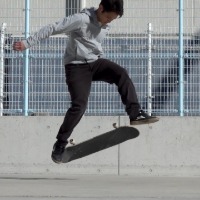
In another Tip (Link), we explained that from a physics perspective, to make the board rotate most efficiently, your front foot should apply force perpendicular to the board’s axis of rotation. This means that when the tail is popped and the board is angled, you can rotate the board most effectively by flicking your front foot diagonally downward. It might seem like your front foot would hit the ground if you flick downward, but no matter how strongly you flick your foot downward, as shown in the video, as long as your whole body and knees are rising, your foot will continue to rise. Look at the height of the yellow line indicating the distance from the ground—it continues to rise until the flick motion is completed.

What to Do
Get used to the feeling of flicking downward
As explained, from a physics perspective, the most effective rotation comes from flicking your front
Analyze
A common misconception: flicking your foot diagonally upward
As explained, your front foot always rises in terms of its height from the ground. However, this does not mean that the board somehow rotates just by sliding your foot diagonally upward. To repeat, what is physically required is a downward diagonal force. As the board rises and your whole body rises, your front foot alone is flicked downward—this applies downward force to the board, while still rising relative to the ground. That is what creates the rotation. Try checking your heelflip flick motion in a stationary position. If your front foot is moving diagonally upward like in the video, there is no reason for the board to rotate at that point.