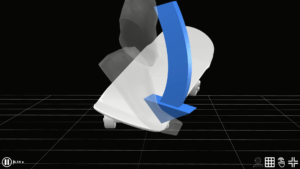
Why does your Treflip not flip?
Because your body is holding the board down.
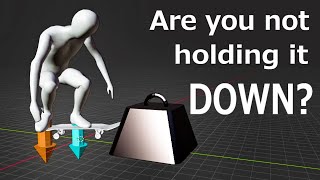

Some skaters can Treflip or Shove-it with remarkable lightness. Understanding the mechanism behind a steezy Treflip helps you achieve the same. The central question explored in this article is: Can you truly scoop the board if your entire body is pressing it downward?
Summary
What does it take to complete a rotation in a Treflip?
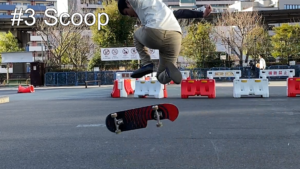
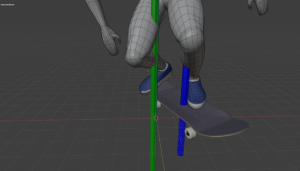
The rotation relies almost entirely on the back-foot scoop, as commonly stated. Focus on rotating the back foot around its vertical axis rather than swinging it forcefully. For further detail, see How to Scoop and Mechanics of Treflip.
Why does a Treflip fail to flip?
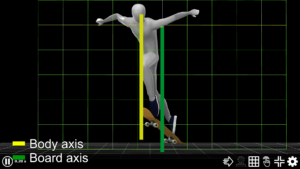
The board flips and rotates effectively only when the body has elevated enough to allow space for the scoop. If the tail is scooped too early, the upward movement of the body suppresses the board’s rotation. A light and efficient scoop becomes possible once your body already has upward momentum.
Simulation













Timeline
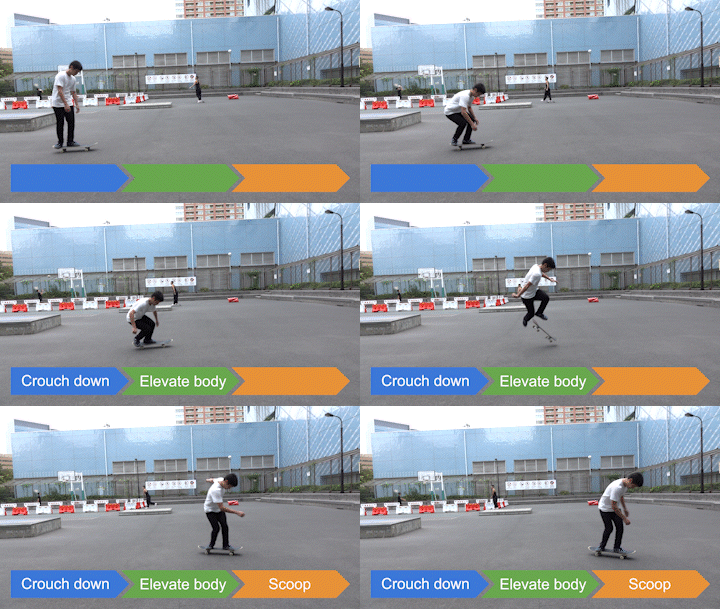
To understand the Treflip more precisely, let us examine the movement in chronological order.
We begin with a deep crouch followed by the upward movement of the body. The scoop occurs only after this elevation. Within this sequence lies a crucial principle behind the lightness of Treflips—one that allows the board to flip far more efficiently.
Visualization using 3D models
Explanation of components
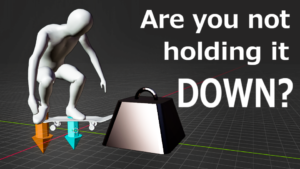
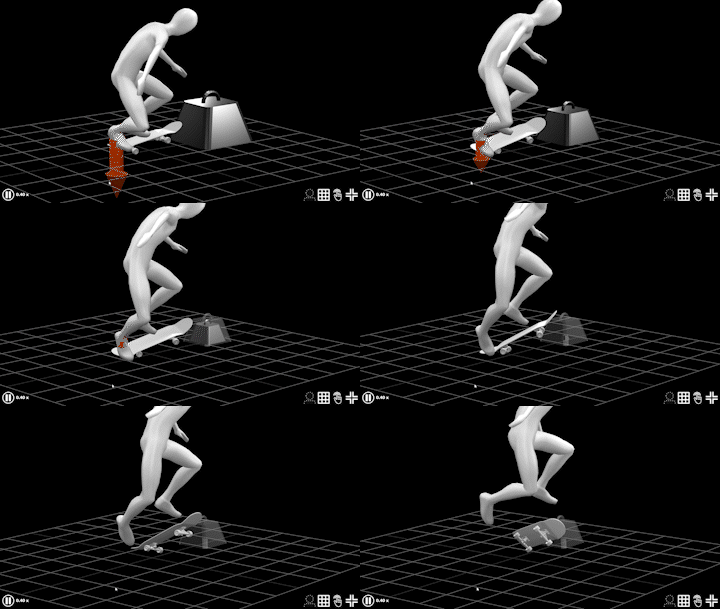
The orange arrow represents the force applied by your back foot, while the blue arrow represents that of your front foot. The weight indicator at the front visualizes the effective weight acting on the board, illustrating how downward pressure increases the board’s “heaviness” and when that increase occurs.

When standing on the ground
You naturally press into the ground to support your body against gravity. This generates a constant downward force.
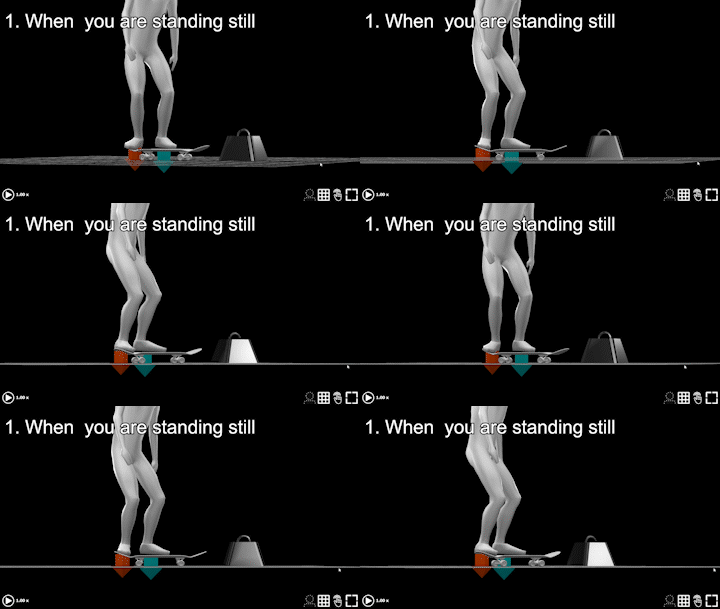
When you start crouching down
This downward force decreases because your center of gravity begins to fall freely, and your legs no longer need to resist gravity as strongly.

When your body reaches its lowest point
Your legs produce a stronger downward force due to the acceleration gained during the descent. This momentarily increases the effective weight on the board.

When you begin to jump upward
As you extend your legs to initiate the jump, you push downward on the board, making it virtually heavier for an instant.

When your body is rising
Once your body has upward momentum, the downward pressure on the board disappears. At this stage the board becomes significantly lighter, creating the ideal moment for a clean and efficient scoop.
Timing of scoop
Note before scooping
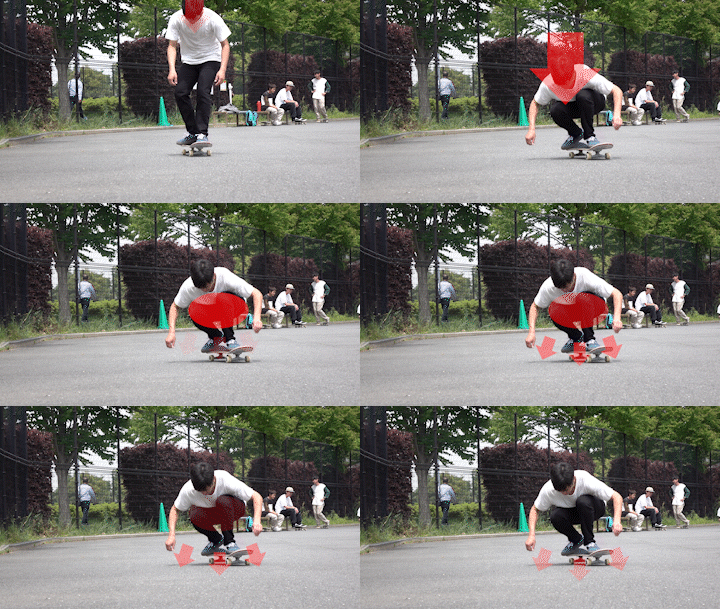
You should avoid crouching and jumping back up too quickly. Jumping immediately after reaching the lowest point dramatically increases the amount of energy required, because your legs must resist the downward momentum accumulated during the descent. As a result, your legs press into the ground even harder while absorbing that momentum.

Hold your movement to dissipate the downward momentum
Pause for a brief moment after crouching down (even a fraction of a second is enough). Doing so allows the downward acceleration to dissipate naturally, making the upward movement much easier and smoother.
What does this have to do with steezy Treflips?
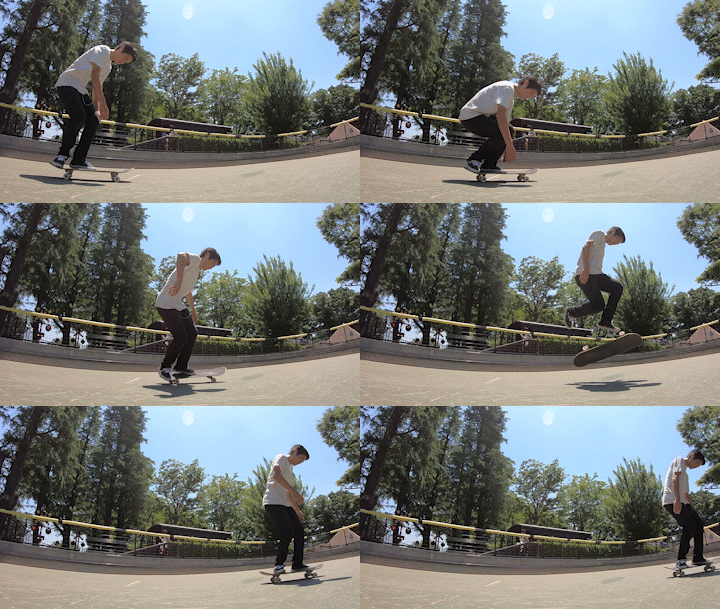
This principle explains why many skaters cannot flip the board lightly, and why others land steezy Treflips with ease. Those skaters simply do not drop too low. By avoiding excessive crouching, they minimize the energy they must absorb and overcome, allowing the subsequent movements—whether scoop or pop—to flow more efficiently.
Lift your body AND scoop
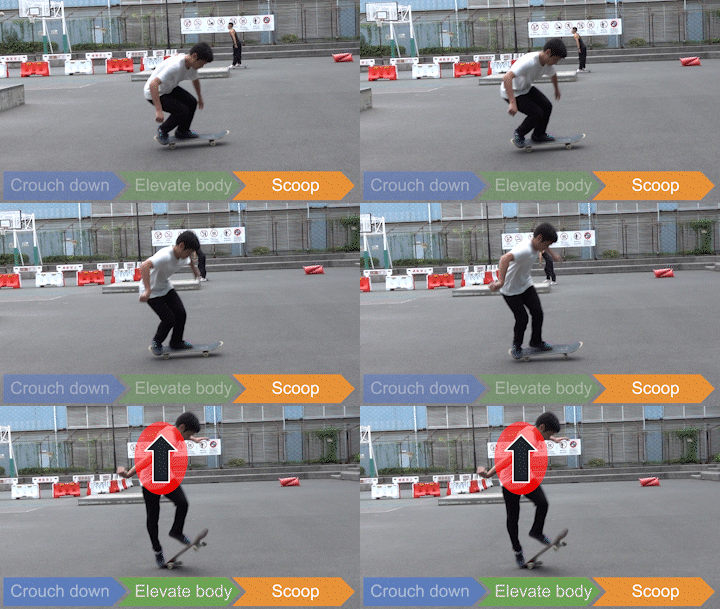
Once you have crouched and briefly stabilized your movement, you are ready to jump. From a physics standpoint, you must push down on the board to lift your body, which increases the board’s effective weight and makes scooping more difficult at that moment.
Therefore, try to separate the upward motion from the scoop. Begin scooping only after you feel your body rising.
Common Questions
Why does a Treflip underrotate or underflip?
If you crouch and stand on a scale, the number fluctuates because your center of gravity gains downward momentum as you descend. When it reaches the lowest point, your muscles must absorb the accumulated energy.
During this phase, you cannot scoop the tail efficiently because the back foot cannot twist freely—it is busy resisting gravity and pressing into the board.

Is it wrong to crouch too low?
Crouching deeply is not inherently bad. Although a deeper crouch increases the gravitational load your body must overcome before jumping, jumping without bending your knees at all is also impractical. For some skaters, crouching is essential for rhythm and timing. What matters most is not avoiding the crouch itself, but neutralizing the downward momentum by briefly stabilizing your movement at the bottom.