Why is it difficult to accept the idea that “Treflips are all in the back foot”?
Because I simply cannot believe it.


Many skaters say that Treflips rely entirely on the back foot and that the front foot hardly plays a role. Whenever I heard this advice, I always wondered, “Is that really true? Don’t I still need my front foot to make the board flip?” For some reason, no matter how often we hear “it’s all in the back foot,” we still tend to involve the front foot.
In this article, we will examine whether this saying is truly reliable by studying the physics and objective mechanics behind Treflips.
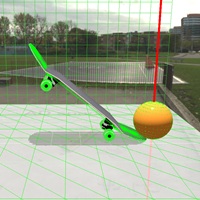
Table of Contents
Logical breakdown of the saying “it’s all in the back foot”.
We begin by examining what this statement actually means from a logical perspective.
Simulations with 3D models.
Next, we remove subjective impressions and observe what physics tells us through 3D simulations.
How to execute the technique.
Finally, we will discuss how to apply these principles in practice.
Simulation











Logical Breakdown
Why do people say “it’s all in the back foot”?
In the previous article, we observed that my front foot leaves the board before it has any opportunity to generate a flick. I also explained that my style of Treflip relies on rebound: as the back foot scoops, the hanger of the rear truck bends and stores elastic energy. When this energy is released, it generates the flip. In other words, a Treflip can be understood as the rear truck returning to its original state.
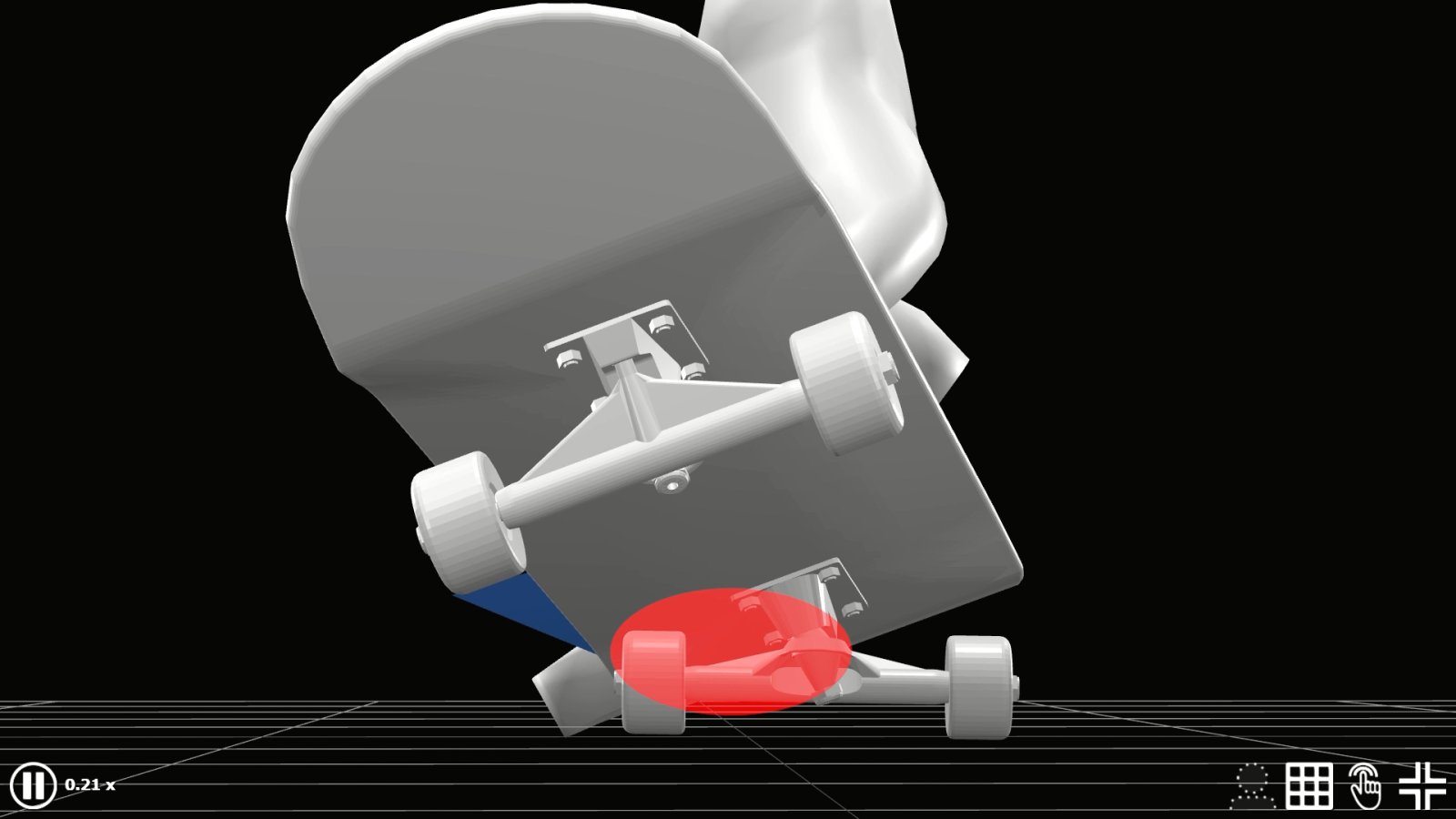
Why do Treflips level out?
At first glance, this may seem unrelated, but understanding it provides important insight into the trick itself. Consider the following:
- In an ollie, you must use your front foot to level out the board.
- In a Treflip, however, the board somehow levels out even though the back foot is doing most of the work.
Why is that? When you think about it, it feels counterintuitive.
What options do we have to level out?
To make the board level in the air, there are two possible mechanisms:
- Push the nose downward, as in an ollie.
- Lift the tail upward by some means.
In my style of Treflip, the front foot does not remain on the board and therefore cannot push the nose downward.
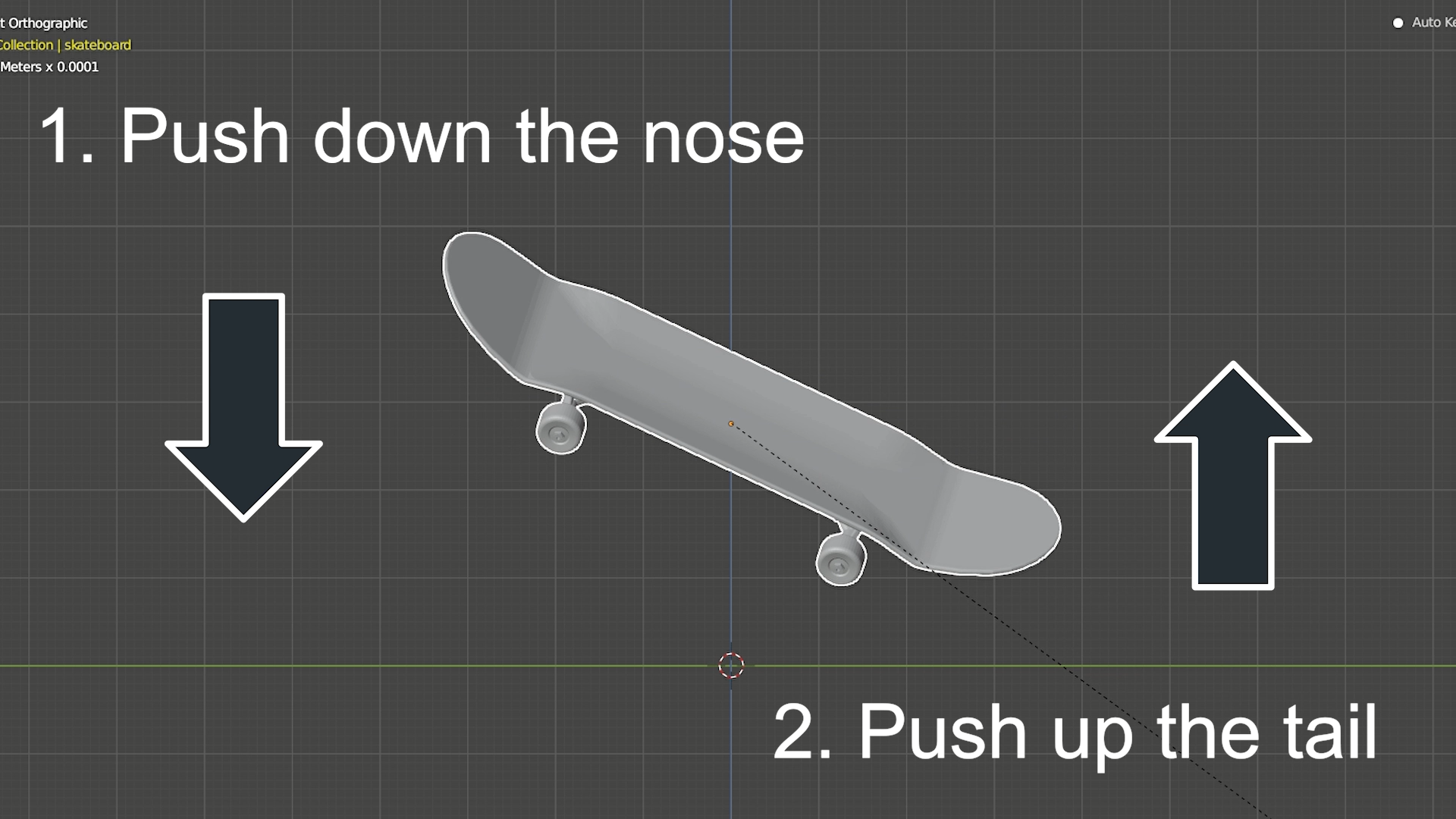
Something pushes up the tail.
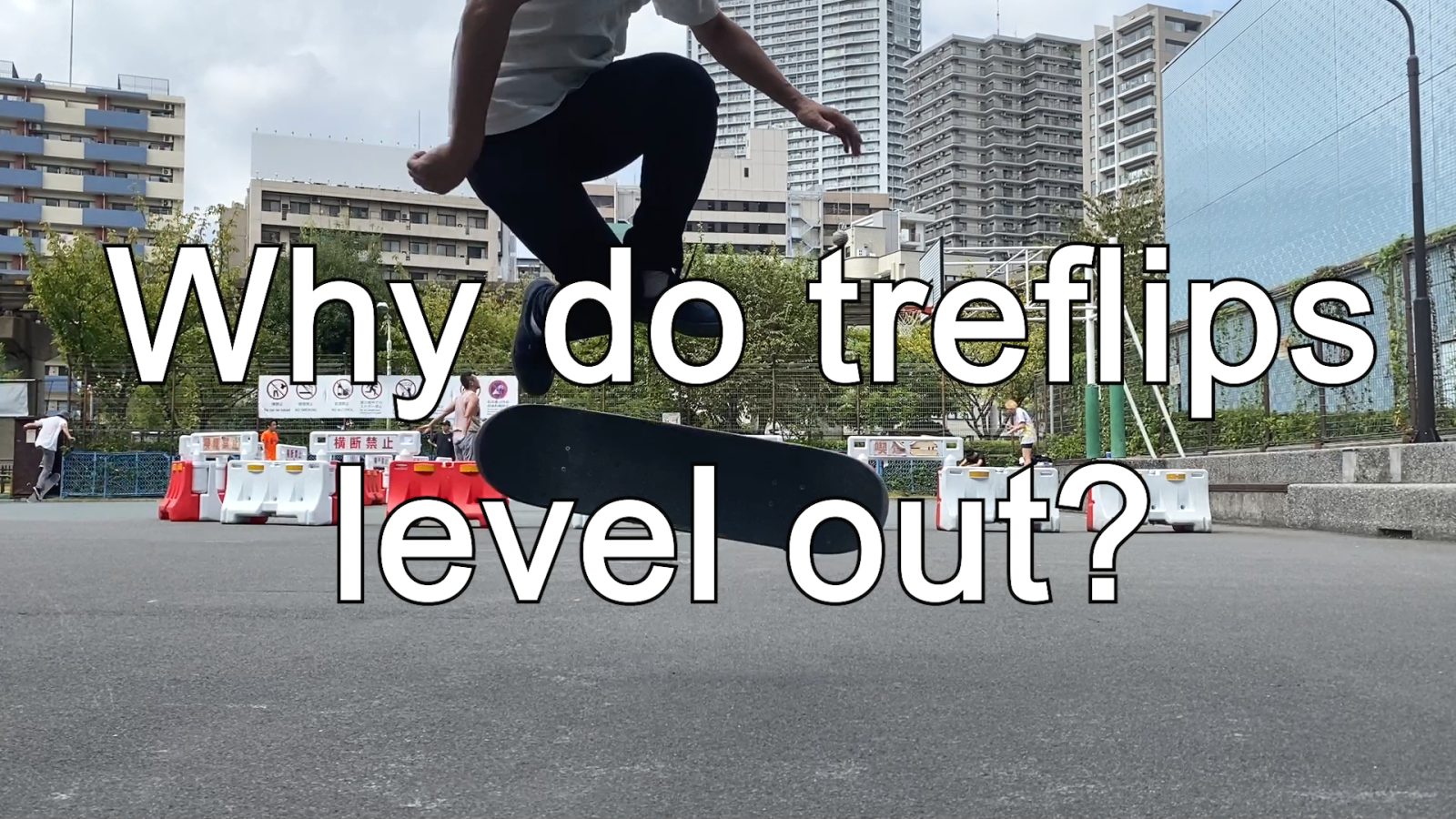
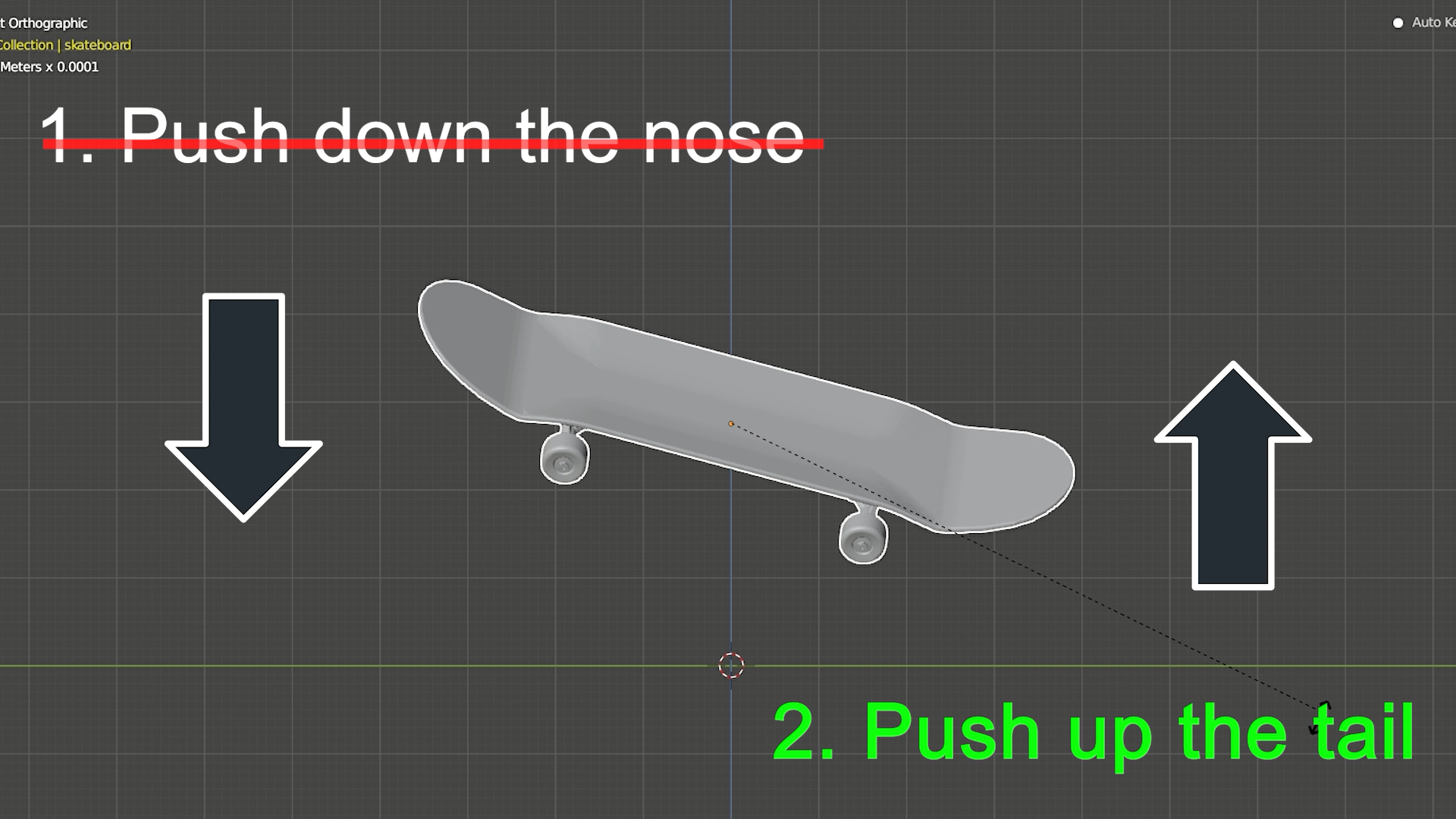
The only remaining way for the board to level out is for the tail to rise. This means that something must be pushing the tail upward. That something is the stored energy in the rear truck. When this energy is released, it produces two effects:
- It lifts the entire tail upward. Combined with the pop, this upward momentum becomes even stronger.
- It flips the board because the force is applied asymmetrically to one side of the tail.
Returning to the earlier question, “Why do Treflips level out?” the answer is: because the rear truck pushes the tail back up. The flip occurs as a secondary effect caused by the uneven force distribution.
This explanation may sound reasonable in theory, but so far it has been based solely on my analysis. To verify the mechanics objectively, let us consult physics through a 3D simulation.
Simulations with 3D Models
Preparation
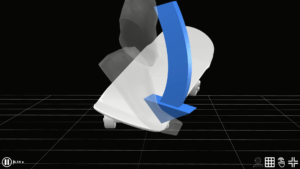
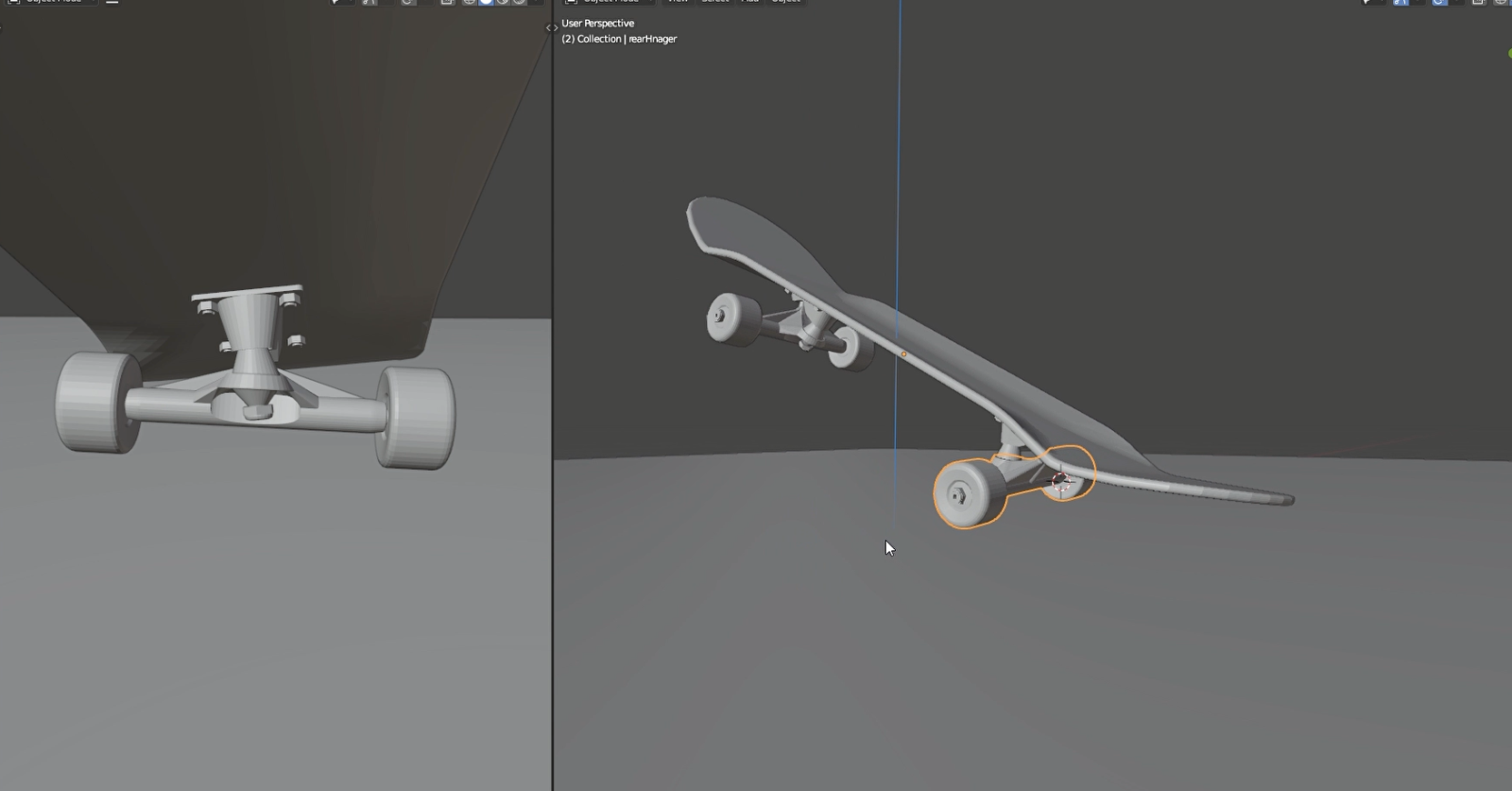
Here we have a 3D model of a skateboard with the rear truck already bent. The size, weight, gravity, and other physical parameters are set to be virtually identical to those of a real skateboard. Although I am currently holding it in place so it cannot move, the rear truck is continuously attempting to return to its original shape.
Let’s see what happens
If we categorize what occurs, there are two major effects:
- The stored energy in the truck lifts the tail upward.
- It also flips the board.
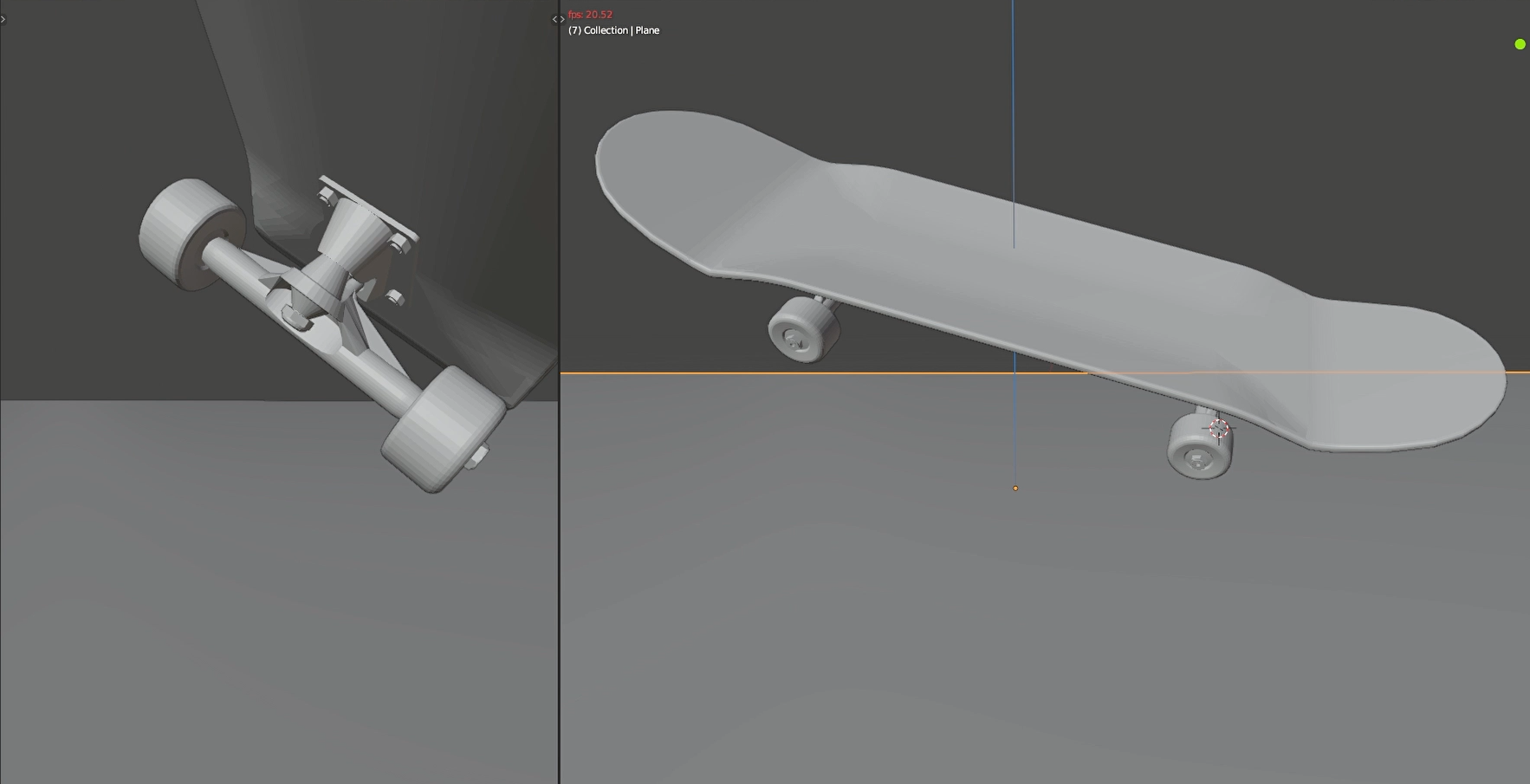
Something is lacking
Although these results align with our earlier hypothesis, you can clearly see that the energy stored in the rear truck is not strong enough to complete a full 360-degree kickflip rotation. Consequently, the board lands primo, and the flip stops immediately upon touching the ground. In reality, we must find a way to give the board both a longer duration in the air and greater rotational momentum.

The role of the scoop
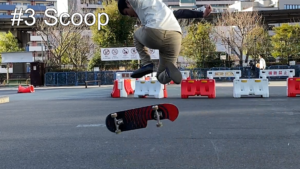
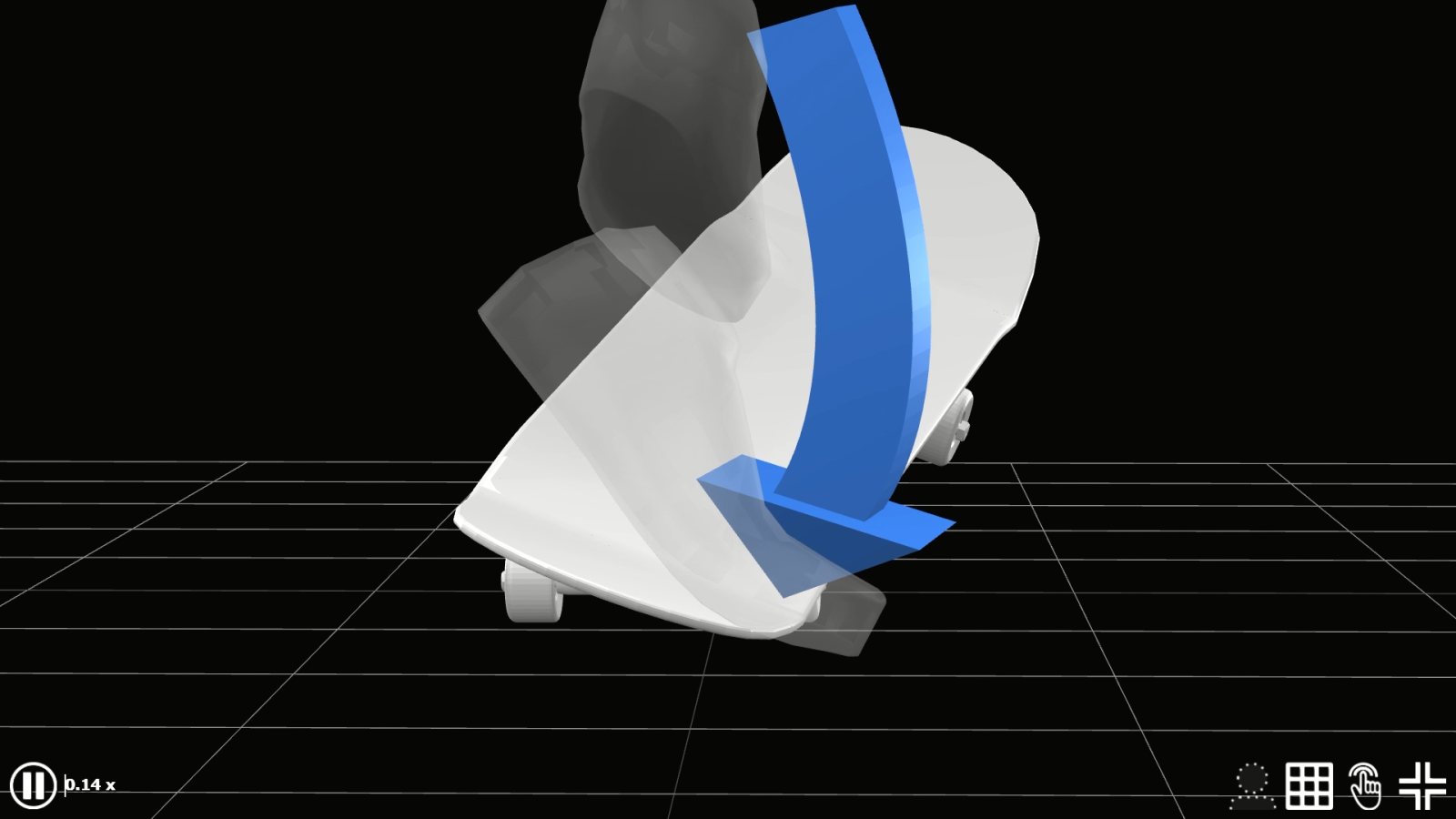
This is where the importance of the scoop becomes apparent. As you scoop, the tail strikes the ground, and the board rebounds from that impact, allowing it to stay longer in the air. At the same time, because only one side of the tail contacts the ground, that side of the tail functions similarly to the rear truck and pushes itself upward, ultimately accelerating the flip that the rear truck initially created.
Execution
What do we need for a Treflip?
Let us now discuss how to perform the trick. As explained so far, a Treflip requires two elements:
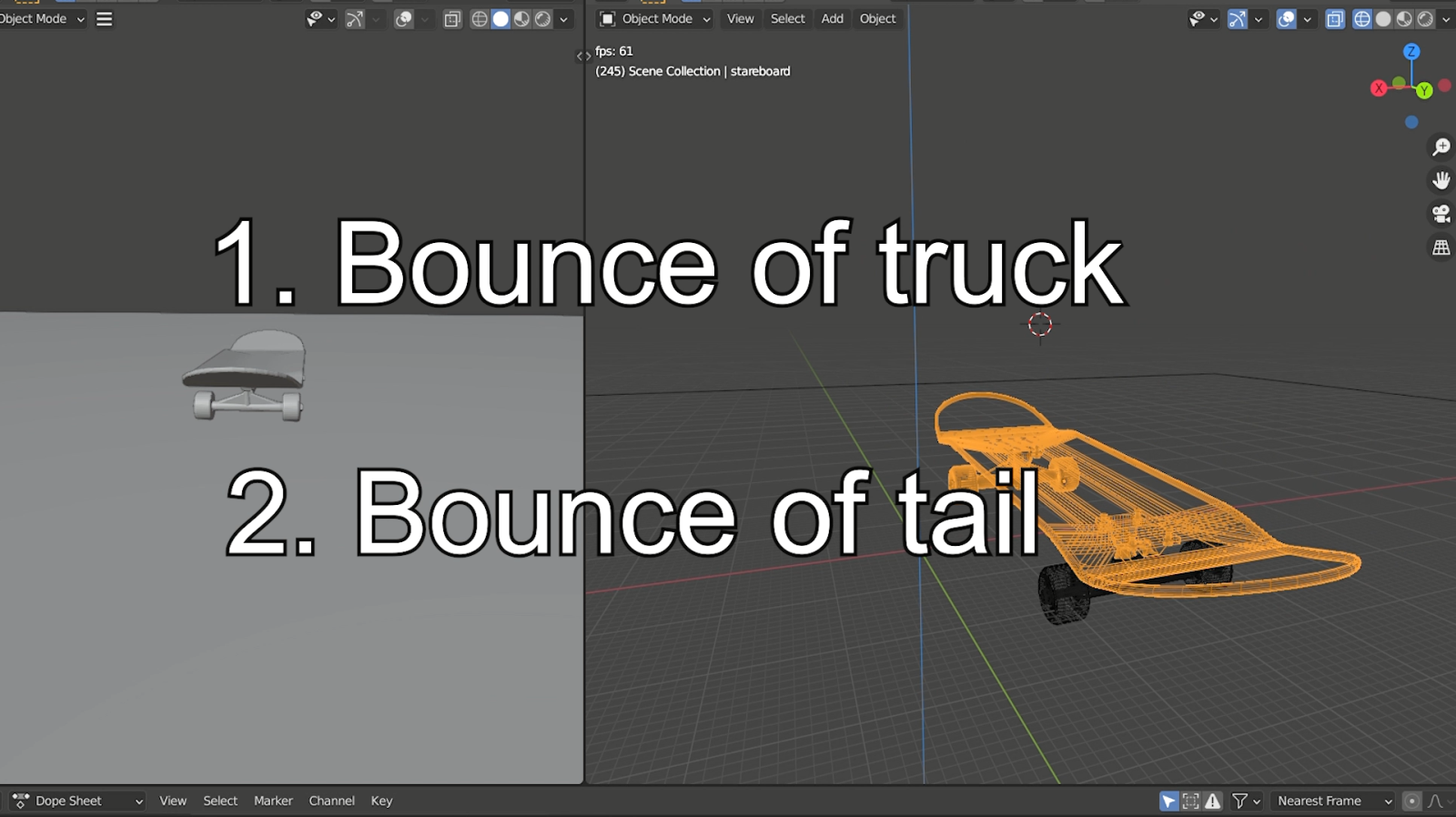
- The rebound of the rear truck.
- The rebound of the tail.
Our goal is simply to combine these two. However, remember this: the kickflip rotation in a Treflip should be primarily generated by the rebound of the rear truck. While the rebound of the tail does add rotational speed, its main role is to elevate the board, not to flip it.
Why do I land upside down?
When you attempt to pop harder, the angle of the rear truck often becomes smaller, making it more difficult to generate the flip. If you consistently land with the board upside down despite being able to spin it with no problem, you may simply be popping too hard. To prevent this, focus on the z-axis rotation we discussed in the previous article.

Do you need to pop while scooping?
You do not need to consciously think about popping the tail. When you lift your body, your feet naturally press downward against the ground due to the reaction force. With proper timing, by focusing solely on the z-axis rotation, you will simultaneously bend the rear truck and allow the tail to strike the ground.