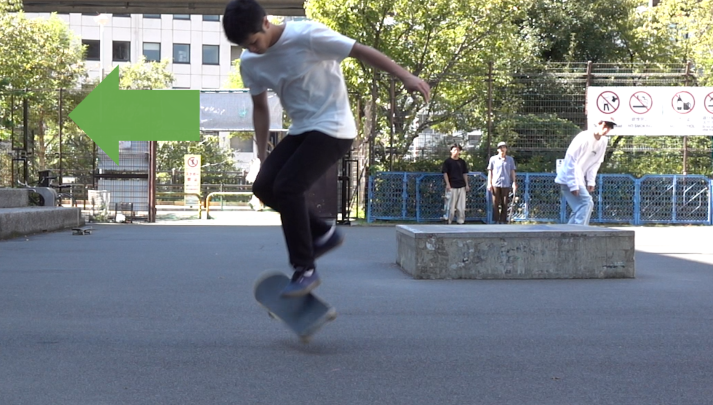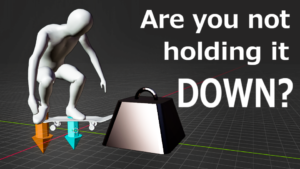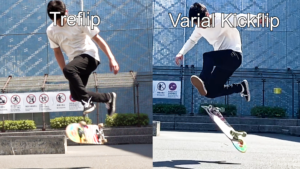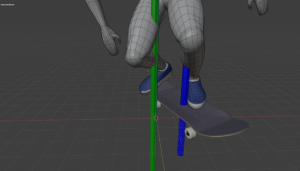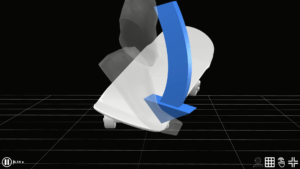
In this article, we scientifically examine the well-known phenomenon that “tre flips become easier when you are moving.” For many skaters (including the author), simply rolling forward—even at low speed—makes landing the trick significantly easier. One of the reasons for this is the effect of changes in weight distribution that occur during motion.

Overview
How should you load your weight?
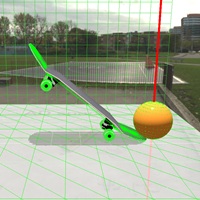
Before leaving the ground, it is effective to shift your center of gravity slightly toward the toe side.
Why does a tre flip become easier while moving?
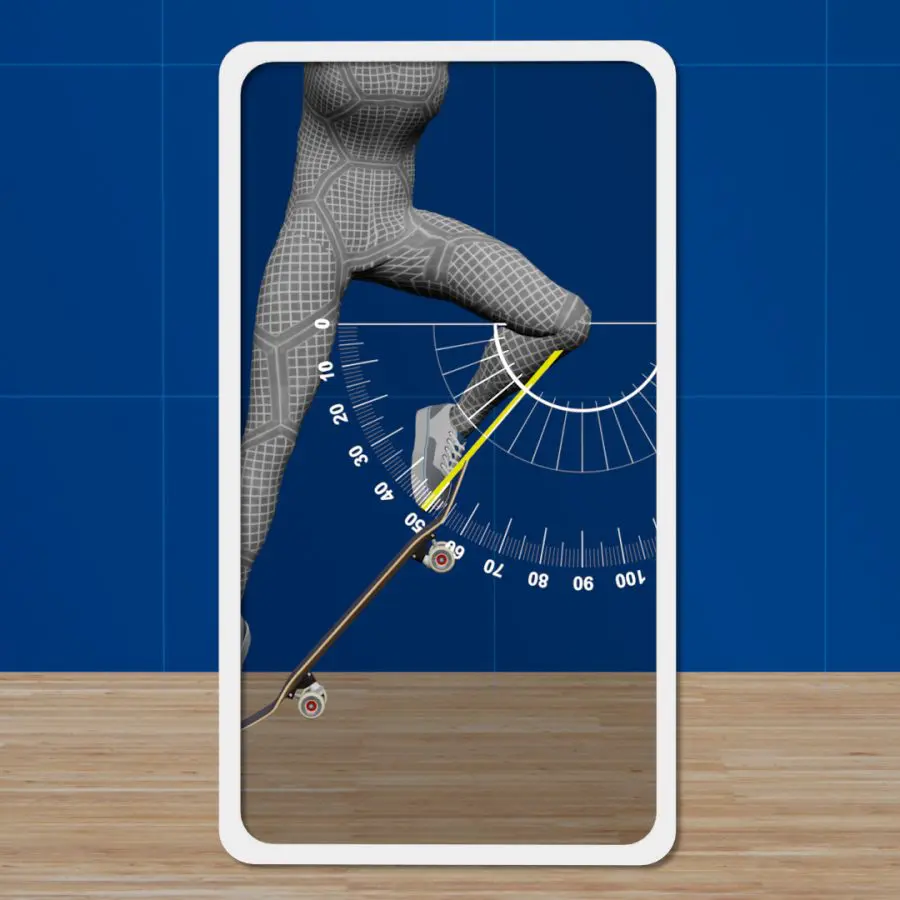
As you crouch down, the deck tends to open toward the frontside. When you are rolling forward, this motion makes it easier for your weight to shift toward the toe side, increasing the force that rotates the board.
How far forward should you jump?
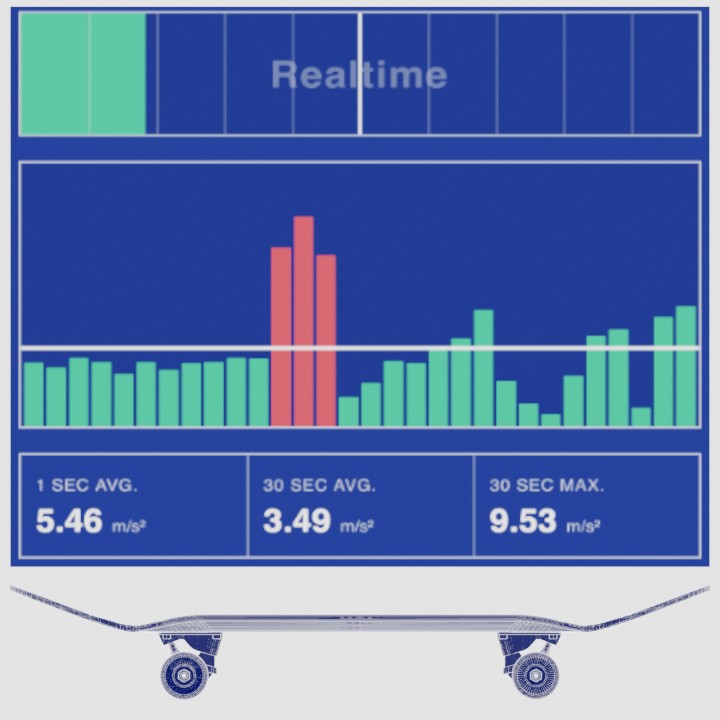
The optimal distance varies depending on many factors, such as body weight, setup, speed, and the hardness of the bushings. Ultimately, you need to discover the optimal weight distribution through your own practice.
Simulation












Clarifying the Assumptions
Board trajectory
To understand why tre flips become easier while moving, we first need to clarify what kind of trajectory the board follows.
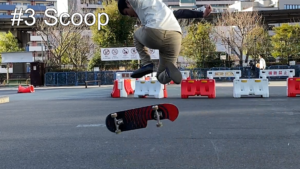
When you scoop the tail (see the previous article for details), the toe-side wheel of the back truck catches the ground as a pivot, and the deck naturally lands toward the toe side.
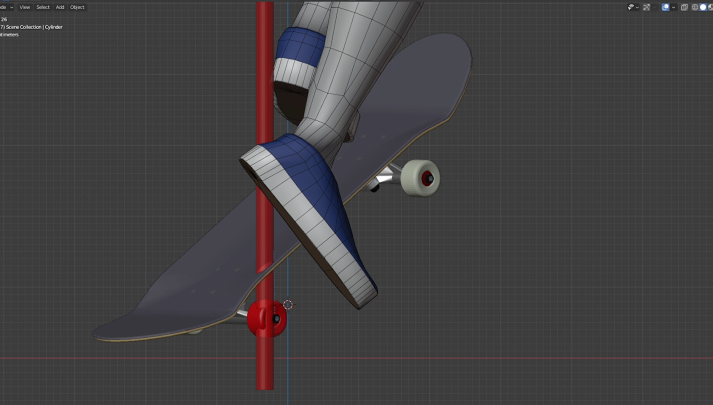
Your body must also land toward the toe side
To successfully land the trick, your body must remain positioned directly above the deck at all times. This follows the same principle as a pop shove-it.
If you pop while your feet are not directly under your center of gravity, your body will end up moving in the opposite direction from your feet.

Your body will move toward the toe side even without jumping hard forward
If your center of gravity is already shifted toward the toe side, there is no need to force yourself to jump forward. This is because physical laws (action and reaction) naturally carry your body in that direction.
As a result, your body appears to “float” directly above the direction the deck is traveling, and as you descend, the deck slides back underneath your body.
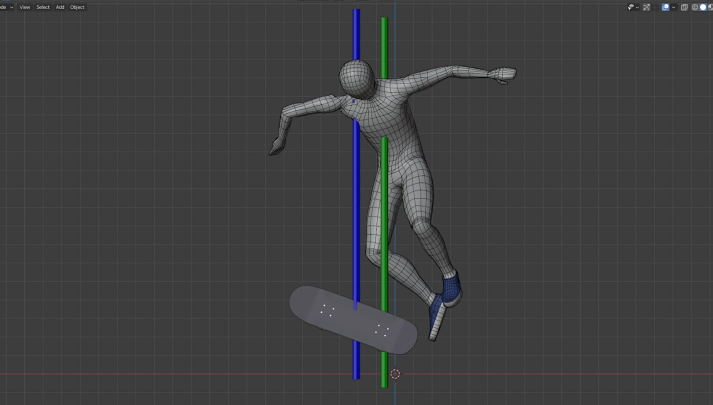
Important: weight shift first, jump second
This order is extremely important. If the deck moves toward the toe side first, you will no longer be able to get back on top of the deck afterward.
This is similar to how it is physically difficult for Tao Pai Pai in Dragon Ball to throw a pillar, then jump onto it after it has already been launched.
Therefore, completing the weight shift before jumping is more important than anything else.
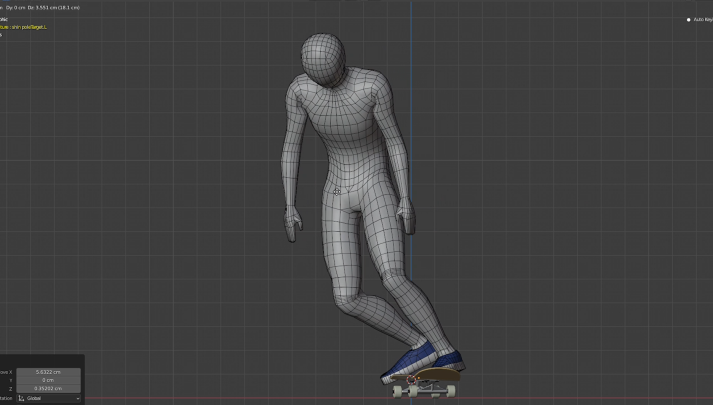
Analysis
Reorganizing the key points
So far, we have explained the importance of positioning your body toward the toe side before jumping, but we now need to analyze the board’s movement in a bit more detail.
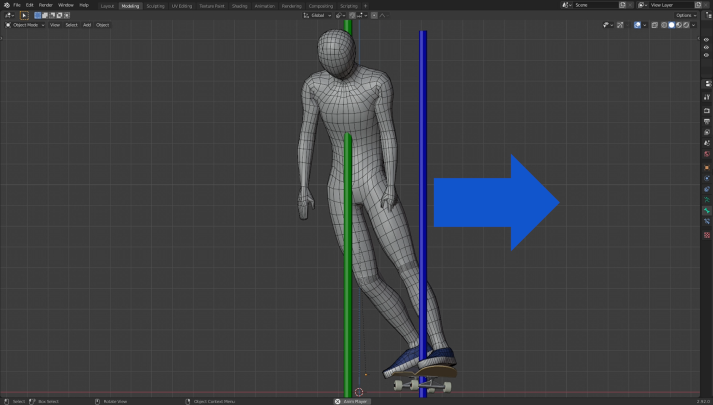
At first glance, this may seem strange, but in my tre flip, the board moves toward the heel side during the approach. Why does this phenomenon occur?
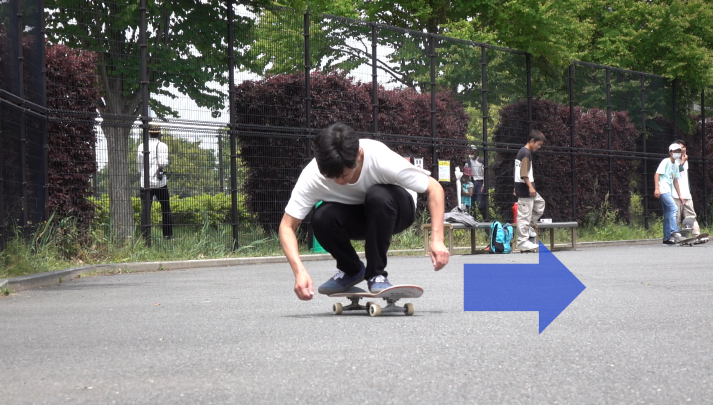
As I crouch down, most of my weight is placed on my front foot.
Because the front foot is positioned closer to the heel side of the deck, it presses down on the heel side. Since the board is moving, the deck begins to turn in that direction.
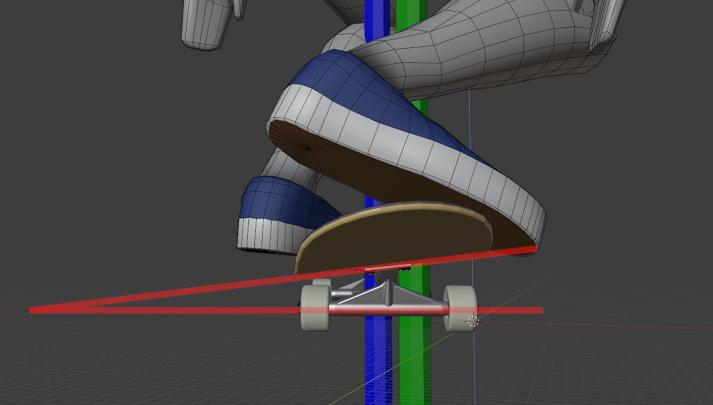
As you rise from the crouch and the load on the front foot is released, the force pressing down toward the heel side disappears.
Once this tilt is resolved, the turn toward the heel side stops.
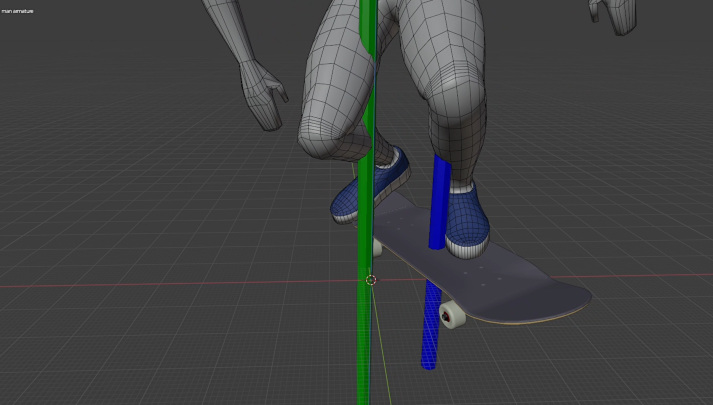
On the other hand, when performing a tre flip from a stationary position, even if the deck tilts due to the same physical factors, there is no forward motion, so the deck does not move toward the heel side.
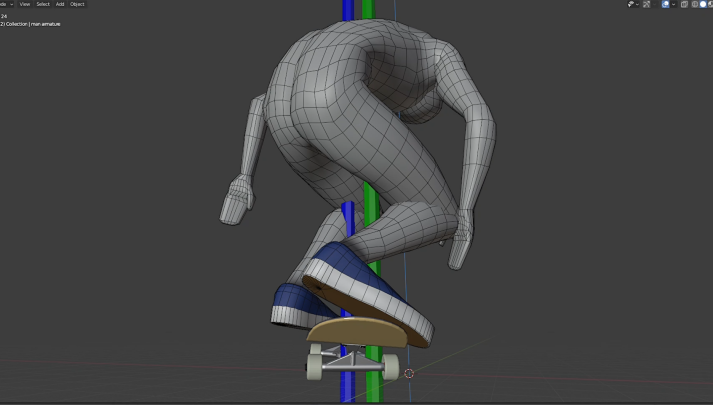
Depending on your setup, the deck may not tilt as easily as mine. In such cases, you need to jump forward more aggressively.
Many factors influence the behavior, including body weight, speed, bushing hardness, and truck geometry. Be sure to explore the optimal weight distribution that matches your own physical characteristics and setup.