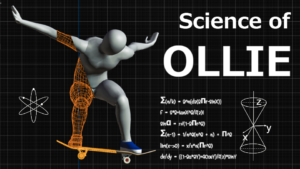
You are doing everything you can do, but your Ollie is not getting nearly as high as good skaters. In fact, crouching on a skateboard is so delicate that you can easily lose balance, which makes it harder to jump higher. In that sense, the reason you can't jump higher is that you are trying to jump higher. Let's see how to improve it, then.
Instantly discover issues with your tricks and how to fix them.
Deep analyze your motion with the cutting-edge technology.

Track your daily progress and ask questions to others.
Review of The Components of Ollie
Let's review the basic components of an Ollie. As explained before, you need both a pop and a jump in an Ollie. You can't Ollie really high by popping the tail alone because it does not lift your body weight off the ground.
A Case Study: Beginner vs. Experienced Skater
Let's take a look at an Ollie of Dom. He understands that simply popping the tail is not enough. So, he tries to lift his body before popping. So, theoretically, he's doing what is needed: Crouch, jump, and pop. But somehow, he lands on the ground almost immediately afterward.
Now, let's also take a look at my friend German's Ollie. He's got a relaxed, effortless, and clean Ollie. Please take a look at it on the AR system, too.
So, what makes their movements look so different? They crouch like the same, they pop like the same, with some differences in the upper body, though. He IS popping and jumping using all the strength he has. So, does he simply have to jump higher when he's already doing everything he can? No. It's not about how much force you put into it; it's about establishing a foundation that you feel comfortable jumping on, which helps you increase the jumping speed.
The Difference in Jump Speed
We'll talk about how to crouch stably later, but let's first actually calculate the speed of their jump. For Dom, if we do the math of the average speed of his center of mass from the moment it reaches its lowest point until the tail hits the ground, we get 89 cm/s.
(105 cm − 81 cm) / 0.27 s = 89 cm/s
If we do the same for German, we get 270 cm/s:
(115 cm − 69 cm) / 0.17 s = 270 cm/s
The Effect of Jump Speed
So, what does that difference do in their Ollies? Simply put, the faster you jump, the higher you can jump. Try it yourself. Lower your hips and then jump quickly. You should be able to jump without a problem.
Now crouch to the same height, but try to jump very slowly. You will probably find that you can barely jump at all.
Things become clear if you think about lifting an object, such as a helmet. If you lift it quickly, even after your hand stops moving, it continues rising. But if you lift it slowly, the helmet naturally stops as soon as your hand stops.
You can't change this nature only by lifting it higher. As long as your movement is slow, at the moment you let it go, it begins falling, no matter how high you raise it.
The same principle applies to an Ollie. No matter how much you raise your body from a crouched position, if you do it slowly, your body will not gain upward momentum.
What's even worse, all that up-and-down movement simply tires your legs without providing any benefit.
Why Jumping Becomes Difficult
And in order to jump higher, you must understand why jumping becomes difficult. It's a simple action, and it should be easy. The biggest and most overlooked reason is instability while crouching. Let's go back to Dom's example. When he crouches, his legs shake as if he's searching for a position where he can balance. It resembles the trembling legs of someone standing on a tightrope. If you wonder why you can't Ollie or jump so high, ask yourself: Can you jump on a tightrope? I probably can't.
As I said in a previous video, there's a certain spot where you can balance firmly, which I call the Squat Sweet Spot. You need to find this spot to jump stably.
Due to a mechanism called the Stretch Shortening Cycle, you can maximize the height of your jump by crouching and instantly jumping back up, compared to waiting before jumping. So, if you can drop yourself into this specific position, you can literally maximize the height of your jump.
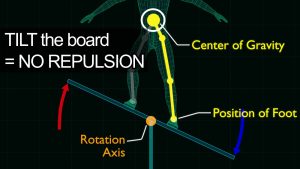
But the thing is, you are squatting on a skateboard that has a unique structure. Although a skateboard has four wheels, the parts that support your body weight are the pivots of the trucks. So, if you lean to one side, the truck tilts. And the more aggressively you crouch, the more likely you are to tilt your board, which you have to readjust, causing instability while crouching.
How to Crouch Stably
In order to maintain balance while crouching, try lowering yourself more slowly. Instead of dropping yourself into the crouched position all at once, take some time and gradually lower yourself, and then pop. Yes, you CAN'T Ollie so high by squatting slowly, but you can always move on to higher Ollies by jumping more instantly once you start feeling comfortable.
What you must avoid is jumping up slowly, which does not give your body any momentum to go higher. It's just like when you raise a helmet, it can't go any higher if your motion is slow. On the other hand, while crouching slowly may lower your Ollie, you can still jump, and it definitely helps you crouch more stably.
Bonus
Lastly, what would happen if you could raise your body at the speed of sound?
h = v^2 / 2g = 343^2 / 2*9.8 ≈ 6km
You would launch yourself about 6 kilometers off the ground. It seems to be a bit too high for a normal skating scene. Of course, this is an extreme example, but this is how important the speed of a jump is.