

A narrower deck feels easier to flip. A wider deck feels more stable. But are those actually true? And if they are, how much of a difference do they really make?

Assumptions
We'll use 7.75 inch (2.1 kg), 8.0 inch (2.2 kg), 8.25 inch (2.3 kg) decks. Each deck will use trucks that match its width. Everything else, including the wheels and bearings, will be exactly the same.
Effects on Flip Tricks
First, physically, wider objects tend to be harder to rotate because of the weight distribution. Imagine there are two boards with the same weight. One has most of its weight concentrated in the center, while the other has most of its weight distributed near the edges. If you apply the same force, the latter one will spin more slowly.
As the deck gets wider, it doesn't just become heavier. More of its mass is also distributed farther away from the center. As a result, a wider deck becomes harder to rotate.
Being wider also means it gives the board more leverage. The wider a deck is, the farther its edges from the center of rotation become. Compared with a narrower deck, this gives you more leverage, making the board easier to rotate.
What would happen when we combine them? If the force required to rotate an 8-inch deck by 360 degrees is applied to the other decks, a 7.75-inch deck would rotate about 389 degrees, or about 8% more.
An 8.25-inch deck, on the other hand, would rotate about 334 degrees, or about 9% less.
In this comparison, complete skateboards with widths of 7.75", 8.0", and 8.25" are approximated as simple rigid boards with geometrically similar lateral mass distributions. The total weight of each complete is assumed to be 2.1 kg, 2.2 kg, and 2.3 kg, respectively. Deck length, shape, concave, and material are assumed to be identical, each deck uses appropriately sized trucks, and the wheels and bearings are assumed to be the same across all three setups. It is further assumed that the same force is applied in the same direction for the same amount of time to each board, after which each board continues rotating freely in the air for the same duration. Air resistance, deck flex, friction with the rider's foot, and other real-world effects are ignored. Resistance to rotation is assumed to increase as more mass is distributed farther from the axis of rotation, and, assuming similar lateral mass distributions, is approximated as Weight × (Deck width)². Relative rotation compared with the 8.0" setup is therefore calculated as (2.2 × 8.0²) ÷ (Weight × Width²). Using this expression, the 7.75" setup gives (2.2 × 8.0²) ÷ (2.1 × 7.75²) = 140.8 ÷ 126.13125 ≈ 1.1163, meaning that if the 8.0" board rotates 360°, the 7.75" board would rotate approximately 401.9°. Likewise, the 8.25" setup gives (2.2 × 8.0²) ÷ (2.3 × 8.25²) = 140.8 ÷ 156.54375 ≈ 0.8994, corresponding to approximately 323.8° when the 8.0" board rotates 360°. However, when the same force is applied in the same direction, applying the flick farther from the axis of rotation produces a greater rotational effect. Assuming the distance from the deck center to its edge is proportional to deck width, flick effectiveness is approximated as Width ÷ 8.0. This gives 7.75 ÷ 8.0 = 0.96875, corresponding to 348.75° if the 8.0" board rotates 360°, and 8.25 ÷ 8.0 = 1.03125, corresponding to 371.25°. The final estimated rotation is obtained by multiplying the rotation-resistance ratio by the flick-effectiveness ratio, giving {(2.2 × 8.0²) ÷ (Weight × Width²)} × (Width ÷ 8.0), which simplifies to (2.2 × 8.0) ÷ (Weight × Width). Substituting the values for each setup gives (2.2 × 8.0) ÷ (2.1 × 7.75) = 17.6 ÷ 16.275 ≈ 1.0814 for the 7.75" board, corresponding to approximately 389.3° when the 8.0" board rotates 360°; (2.2 × 8.0) ÷ (2.2 × 8.0) = 1, corresponding to 360° for the 8.0" board; and (2.2 × 8.0) ÷ (2.3 × 8.25) = 17.6 ÷ 18.975 ≈ 0.9275, corresponding to approximately 333.9° for the 8.25" board.
If you're catching the board just before Primo, 8-9% of a difference could become significant. Compared with an 8-inch deck, an 8.25-inch deck rotates about 26 degrees less. That difference could be enough to make you land on your board upside down.
How Deck Width Affects Turning
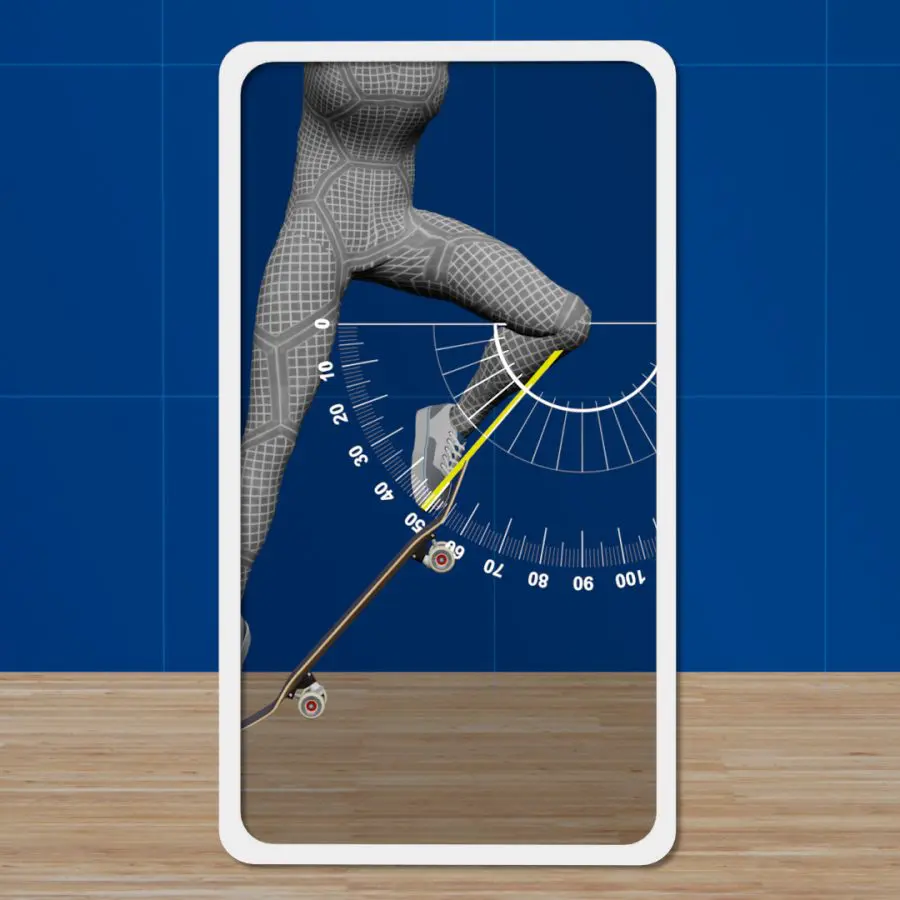
Next, let's look at turning performance. When you turn on a skateboard, you lean the deck in the direction you want to go. Because of the leverage effect we discussed earlier, by applying the same force to the edge of these decks, they lean by roughly 3% different amounts.
If you keep on riding, the size of your turning arc would surely change. However, since the difference is only about 3%, it's probably small enough to ignore. So overall, the effect of deck width on turning performance is quite limited.
How Deck Width Affects Stability
The word "stable" can mean different things, so in this video we'll define stability as having less toe-to-heel tilt, which is something many beginners struggle with. In fact, a wider deck allows your feet to contact the board farther from its center. While it does give you a wider space to stand on, as explained earlier, that actually makes the board easier to tilt.
When the deck tilts too much, it can touch the wheels, causing wheel bite, which acts like a sudden brake. To prevent it, wider decks are often paired with harder bushings or riser pads. These components help prevent wheel bite even if you put your weight on one side more. They also allow the board to respond more flexibly to your balance. As a result, the setup may feel more stable. In other words, it's not the wider deck itself that increases stability. Of course, different physics come into play when you're riding at high speeds or skating large sections, but let's talk about it some other time.