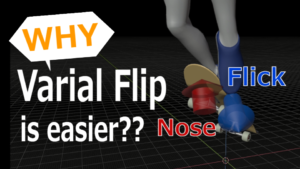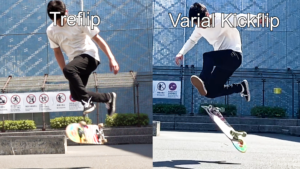

Some people find Varial Kickflips are easier than normal Kickflips. But why? The motion of Varial Kickflips is more complex. In this article, we will see the scientific difference between these tricks.
Instantly discover issues with your tricks and how to fix them.
Deep analyze your motion with the cutting-edge technology.

Track your daily progress and ask questions to others.
Summary
Why are Varial Kickflips easier than Kickflips?
There are two primary reasons:
1. The nose does not collide directly with the front foot, reducing resistance and
allowing the front foot to extend more freely.
2. Flicking the front foot forward is biomechanically more natural than the diagonal
heel-side flick required in a standard Kickflip.
How to practice the Varial Kickflip
Pop the board exactly as you would for a Pop Shove-it. Use the tip of your toe and flick forward.
Simulation












Premises
The best moment to flick the board in flip tricks
Right before the board loses its upward momentum after the pop, it briefly enters a near–zero-gravity state. At this instant, the board can be flipped with a remarkably small amount of energy — almost as if you could flip it with just a finger.

Why a Kickflip is harder than a Varial Kickflip
When learning Kickflips, skaters often pop too powerfully, giving the nose excessive upward momentum. Ideally, the nose should have lost most of that momentum by the time the front foot begins the flick. However, when you pop the tail using the full force of your body weight, the board gains far more energy than necessary.
This energy does not dissipate on its own; your front foot must remove that excess energy during the flick.

How to reduce the nose's energy in a Kickflip
There are two possible approaches:
- Jump higher and slide your front foot upward, allowing the board to lose momentum as it rises. This is technically challenging for beginners.
- Use your front foot to press down on the nose to consume the excess energy. However, the energy generated by a strong pop usually exceeds what your front foot can absorb while flicking.

Comparison between a Varial Kickflip and a Kickflip
Key difference between the tricks
In a Varial Kickflip, the nose’s remaining energy does not collide directly with the front foot. If excess momentum remains, it is dispersed into the air as the board rotates horizontally. As a result, the front foot does not need to absorb all of the nose’s energy, significantly reducing the physical burden of the flick.

How to perform a Varial Kickflip effectively
Pop in a Varial Kickflip
Pop just hard enough for the board’s nose to rise to the level of your front foot. If you pop harder than necessary, the board creates excessive friction against your front foot. Focus on keeping the nose in controlled contact with your front foot rather than generating unnecessary upward force.

Flick in a Varial Kickflip
In a Varial Kickflip, you can flick the front foot naturally forward — a motion that aligns well with natural human leg movement.
In contrast, the Kickflip requires a diagonal flick toward the heel side, which is biomechanically less natural. Some skaters compensate by shifting their weight to the heel side before jumping, allowing them to flick straight forward.