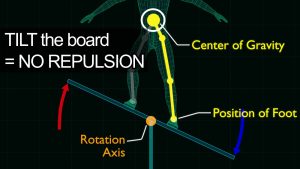
In this article, we explain the scientific elements required to keep the board level.
Instantly discover issues with your tricks and how to fix them.
Deep analyze your motion with the cutting-edge technology.

Track your daily progress and ask questions to others.
Simulation
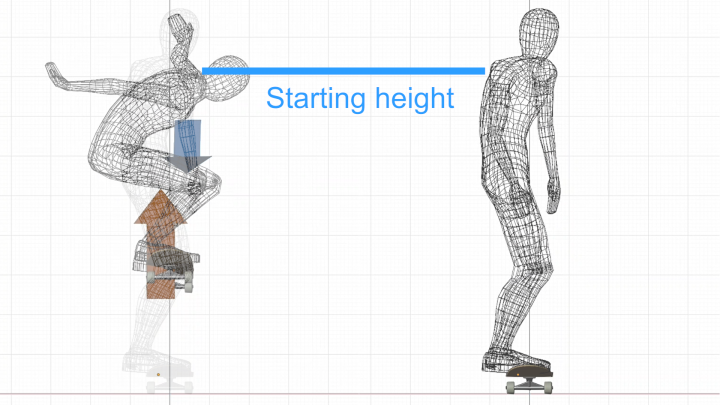
If the blue arrows are not visible, try zooming out slightly.













The use of upper body
The role of the upper body from the viewpoint of energy conservation
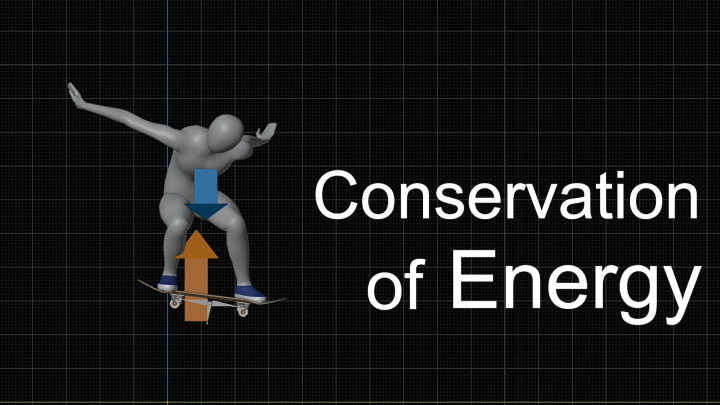
The movement of the upper body greatly affects how easily you can lift your back foot. This relates to the concept of “energy conservation.”
The disadvantages of jumping too high
It is best to avoid lifting the upper body more than necessary or jumping too high. People often assume that jumping higher is better, but in reality, it can interfere with the motion of lifting the back foot.

The basic principle of “reaction”
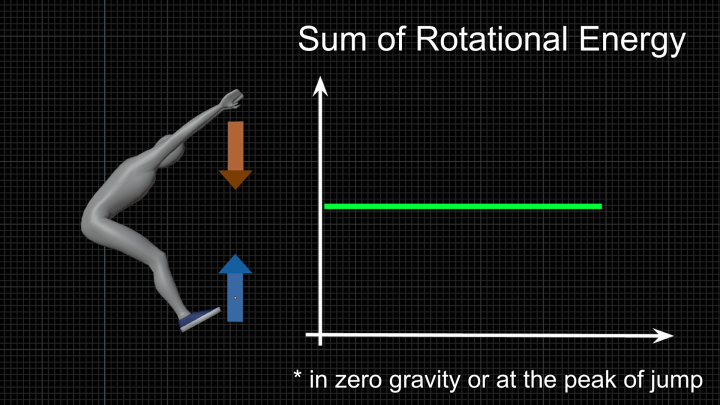
To understand why jumping too high makes it harder to raise the back foot, first imagine the action of pushing strongly against the ground to jump upward.
Once in the air, if you try to lift your upper body even higher, you extend your lower body downward. At that moment, as a reaction to the lower body moving downward, the upper body moves upward, preserving the system’s overall energy.
Application to the ollie
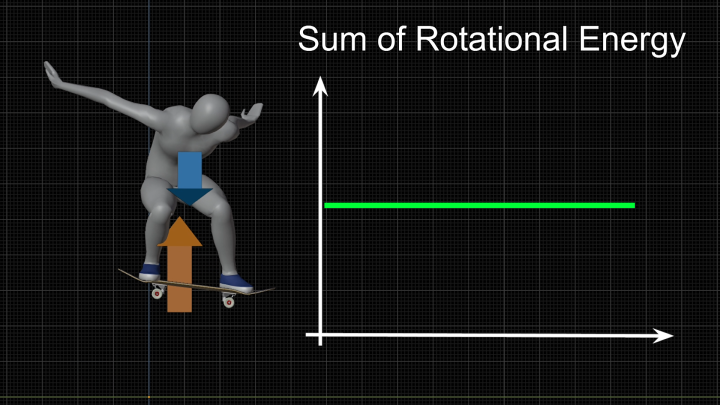
This idea also applies to the motion of an ollie. It may feel counterintuitive, but slightly lowering your upper body allows you to pull your back foot up higher.
When part of your body moves in one direction in the air, another part moves in the opposite direction to conserve overall energy. By lowering your upper body at the peak of the ollie while lifting your back foot, you can compact your body more efficiently and promote the upward motion of the back foot.
Why raising the upper body too much makes the front foot rise excessively
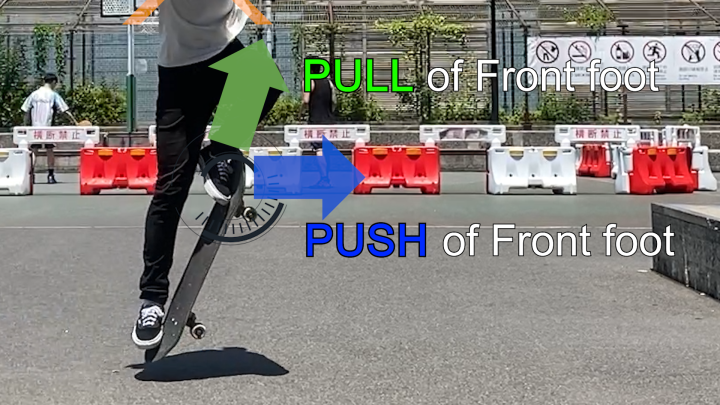
This principle also explains why it becomes difficult to push the nose forward. When the upper body is lifted too high, the front foot is simultaneously pulled upward. As a result, even if you try to guide the board forward with the front foot, the overall body motion interferes with it.
If you want to lift your back foot higher, lower your upper body
If you want to efficiently lift your back foot, you should not only push off strongly but also take care not to raise your upper body higher than its original position. As you approach the peak of the jump, gradually lower your upper body. Doing so uses reaction forces to help you raise your back foot more naturally.