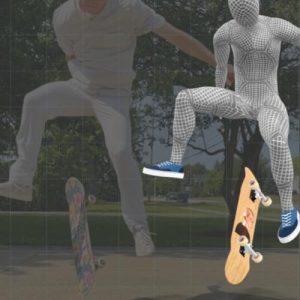
Varial Heelflip is a combination of a Frontside Pop Shove-it and a Heelflip.
1. While some people flick the nose, the board also flips as you flick the end of the concave, and you can choose which part of your foot to use. What matters is to direct your flick almost straight forward.
2. To spin your board, you don't have to jump backward so far because, physics-wise, just like when sitting in a chair, the board spins a lot more easily when it's raised. So, the board spins by jumping just slightly backward.
Instantly discover issues with your tricks and how to fix them.
Deep analyze your motion with the cutting-edge technology.
Track your daily progress and ask questions to others.
A Reason The Board Doesn't Flip
In the first place, why does the board not flip? The secret is in what skateboarding has in common with Football. Imagine it for a moment. You are a soccer player with the strongest kick in the world. Whenever your kick hits the ball, the impact creates a shockwave, and the ball blasts through the stadium wall. The only problem is that your kick doesn't hit the ball. The Varial Heelflip is exactly the same. No matter how hard you kick out your front foot, the board will not flip if your force doesn't reach it.
Case Study
Let's look at an example. Try to spot a difference. This time, Slightly Sketchy kindly helped with the demonstration. From this angle, they look exactly the same, don't they? Yet only my board completely fails to flip.
Now let's look from the front. In the successful attempt(right), at the moment the tail hits the ground, the board pops up vertically. And in the failed attempt(left), the board has already started spinning. So, this angle of the board is key to success.
The Impact of The Board's Angle
So what does the board's angle do? To understand it, we also need to take the path of the front foot into account. As many tutorials explain, the front foot usually flicks straight toward the direction of travel, or slightly toward the toe side. Depending on the person, the foot may stay turned sideways, or the toes may point forward. This itself is simply due to individual body mechanics, so as long as the flick direction does not deviate too much, it is usually not something you need to worry too much about.
The reason the board stops flipping is that it moves away from that path. In a Frontside Pop Shove-it, the board travels behind you, so it's natural that you want to jump backward to land back on it. However, as you lean your body backward, the board tilts, making it much easier for the board to move away from the path of your front foot.
Seen from the side, it's hard to tell what's really happening. But there's a gap between the front foot and the board. If your front foot is no longer in contact with the board, it obviously cannot cause a flip because just like the soccer example, your force does not reach the object.
Jump Direction
In which direction should you jump? In my case, I jump upward as much as possible. Of course, it's not perfectly vertical. But compared to my Frontside Pop Shove-it, you can see that the angle of my jump is much closer to vertical.
Please note that jumping backward itself is not wrong. Some people actually do it that way. It's only that it may become easy for your front foot to detach from your board, and there's a physical mechanism that allows you to spin your board by jumping upward. Which means you don't have to jump backward.
The amount of energy you need to spin an object once becomes rapidly smaller when the object becomes smaller. For example, let's assume the energy you need to spin the board once is 100 when it is flat.
Now imagine raising the board's angle so that its distance from the center of rotation becomes 60% of what it was before. Now the energy you need drops down to 36%, one third of the original value. Of course, popping the tail completely straight down will not create any spin by itself. However, you only need to jump slightly backward or push your back foot forward just a little. That's enough to generate plenty of Frontside spin while also keeping the board in the path of your front foot.
How to Fix the Jump Direction
If you're already used to Frontside Pop Shove-its by jumping backward, you'll naturally want to do the same in a Varial Heelflip. To break that habit, try doing a straight-up Ollie from your Varial Heelflip stance. It doesn't need to be high at all. The goal is to force your body to move straight upward and eliminate the habit of pulling yourself backward.
Once that feels comfortable, add the flick. Once the board starts landing directly beneath your body, you're almost there. Again, we all do it differently as we have different body structures. So if you can flip your board by jumping backward, it's completely fine. Find the angle that suits you the best.
A Common Misunderstanding About the Flick
A common misunderstanding is this: "In a Varial Kickflip, one needs to use the toe to flick the nose, so in a Varial Heelflip, which flips in the opposite way, one must use the heel to flick the nose." It should be one way to do it, but you can also flick the end of the concave. And you may use your heel or other parts of your foot.
You can see that from the front. By the time the heel reaches the nose, the front foot has already left the board. Yet the board flips well. That means the rotational force must already have been applied to the board before the front foot reaches the nose. And that point is around the end of the concave. After that, the front foot cuts through the air right next to the board without touching it.
So, which part of the foot should you use? There's no unique answer to it. Depending on your ankle flexibility and body structure, how much your ankle flexes and which part of your foot comes in contact with the board changes. What matters is NOT which part of your foot to use, but to move your front foot diagonally forward while applying force near the end of the concave. Try different stances and contact points to find what works best for you.