If you want to Ollie higher, pop the tail in a way that you accelerate the energy of the jumping motion. The motion of snapping the ankle is important, but it means nothing in isolation. If you focus only on that, your ankle will lose against your body weight when it is pressing down on it. Find your squat sweet spot to crouch firmly, which helps you jump up stably and ultimately increases your pop. Let's break it down in detail.
The Roles of the Jump and the Pop
First, there are two things you need in an Ollie: a jump and a pop. A jump is the action of lifting your body weight upward using your entire body, while the pop is the action of pushing the tail down mainly with your ankle.
These forces are directed in completely opposite directions. Some perceptive viewers may already be wondering: "Don't we kick downward when we jump?" And that's exactly correct. When you jump, your ankle naturally moves in coordination. In other words, we could say that the jumping motion somewhat includes the motion of popping.
And what's even more important is that the reverse is not true: you can't jump by popping. So, as we need both jumping and popping, popping alone does not let you Ollie really high.
What Happens When You Pop Without Jumping
Let's look at what happens when you focus only on the popping motion. An Ollie that relies solely on the pop is similar to a jump in which you switch your left and right feet. The foot that kicks against the ground receives a reaction from the ground, which pushes your body upward. So, while standing on the ground, popping alone somewhat generates the force of jumping. And it gives you the impression that you just have to pop in the same way.
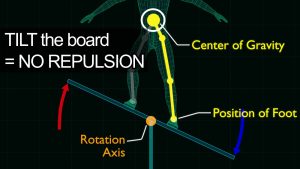
When you stand on a skateboard, however, things change as the tail immediately begins to sink. During that moment, there is nothing pushing your foot upward, and your center of gravity begins to fall. It becomes obvious if you compare them. When standing on the ground, you can somewhat receive repulsion from the ground only by popping. But when on a skateboard, popping alone does NOT lift your body weight as the tail sinks down. And this is exactly why you need to jump in addition to popping the tail.
Does Bending The Back Knee Help?
An Ollie like this causes another problem; the tail doesn't rise. It's not the back foot blocking the movement of the tail, because even if you lift it, it would still separate from the tail. The root cause is that the tail lacks the force to rise.
If your body stays in one place, your front foot is pushed back by the nose, and returns to where it was while canceling out the force of the nose. In other words, the force of the nose is essentially wasted.
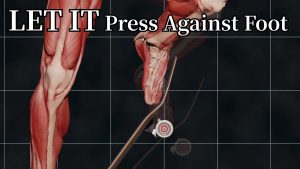
To raise the tail, let the nose push back against your front foot, then raise your body and front foot, which pulls the board up. If you press down on the nose after that, the tail finally rises. So, in that sense, lifting the back foot means nothing if you don't lift your body.
Can the board push your center of mass upward?
Going back to the necessity of jumping, we sometimes hear people say, "By popping, the board lifts and pushes your body upward. So you only need to focus on the pop." But is this actually possible? Let's calculate the conditions required for that to happen.
If an object lifts another object, that is essentially the same as when an object with sufficient momentum collides with and moves another object. Suppose the board weighs 3 kg, the human body is treated as a 60 kg solid ball, and we want to raise it by 30 cm.
If you run the numbers, you'll see the board needs a speed of about 172 km/h. That's roughly the speed of an express train. So, the board needs to hit the sole at that speed to lift our body. Does that already sound too fast? Unfortunately, the situation gets a bit worse.
- Required velocity of the body: v = √(2gh) = 29.80.3 ≈ 2.43 m/s
- Required momentum of the body: Mv = 602.43 ≈ 145.8 kg·m/s
- Required momentum of the board: mu = 3u
- Required velocity of the board: u = 145.8/3 = 48.6 m/s ≈ 172 km/h
The human body is soft and has joints that bend, so a considerable amount of momentum would be absorbed. Suppose that the body absorbs 90% of the force from the board, and only the remaining 10% actually pushes the body upward. In that case, the board would need to travel at about 1,750 km/h. The speed of sound is about 1,225 km/h, so this means the board would be moving at around Mach 1.4. When an object breaks the sound barrier in air, a shock wave is generated. Your eardrums would rupture, and trees would be knocked down. Can you pop that hard? Probably not.
The reason such enormous energy is required is that the board is overwhelmingly lighter than the human body. A light object cannot easily move a heavy one, but a heavy object can easily move a light one.
How can you jump higher?
From a physics standpoint, achieving a high Ollie makes more sense if the heavier body rises using its own energy and, in the process, moves the lighter object—the board. That is why the jumping motion is necessary. So, how can you jump higher? The motion of jumping itself is not different from the one you'd do on the ground. It is essentially the action of pushing your body weight upward using both legs. More important than that, however, is the timing from the moment you crouch to the moment you jump.
As I explained in a previous video, muscles have a mechanism called the Stretch–Shortening Cycle. It is known that by stretching a muscle and then quickly contracting it, the force it produces can be maximized. Try it yourself: compare bending your arm from a stationary state, and starting from the bent state, stretch it, then bend it. The latter should give you a lot stronger pull. The point is, stretching your muscles first increases the strength of the subsequent movement.
In jumping, you can stretch tendons and muscles that are used in jumping by crouching. And you can jump effectively by jumping up right away.
On the other hand, if you stay crouched for too long, the muscles lose their ability to produce a strong force, making it harder to jump effectively. If you compare jumping right after crouching and jumping after some time, you'll see that not only can you jump higher, but it takes a lot less energy when you jump immediately after crouching.
Why you lose balance while squatting?
Intuitively, it seems it's obvious that it's better to jump without taking too much time, but isn't the reason you can't jump right away that you become unstable when you squat? As you feel unstable, your muscles immediately stiffen, and you won't be able to stretch them enough. In addition to the stiffness in your body, correcting your balance takes some time, and your muscles naturally lose their potential energy.
Key to jumping higher
So, the key to jumping higher is not in the motion of jumping itself; it's all about finding the "Squat Sweet Spot." It is the position where you can squat firmly without losing your balance. Being able to jump freely depends on having a stable base when you squat. What matters is that every time, without thinking, you can reflexively lower your body into that position.
The Role of the Popping Motion
Once you can squat firmly, you'll also be able to jump stably, so the only thing left is the pop. But what exactly should you do to pop? A pop is the action of accelerating the wave of force that begins with the jumping motion and transmitting it all the way to the toe.
Don't get overly fixated on the snapping motion of the ankle. As long as you jump properly, this motion will occur naturally to some extent even without consciously thinking about it. For example, try jumping on flat ground. Your toes will remain in contact with the ground until the very end. At that moment, are you consciously trying to snap your ankle? Probably not. When you jump, the ankle ends up snapping as a byproduct of the jumping motion.
Misconceptions About Ankle Snap
It's commonly said that if you stomp the tail flat, your Ollie won't get higher. However, this completely misidentifies the cause-and-effect relationship. It's not because you are stomping the tail that you can't Ollie, but because you are not jumping, which also makes it hard to Ollie, that you stomp the tail. Without jumping, your body stays low and continues to pressurize your board. If you try to pop under that pressure, your foot loses against your body weight and ends up stomping the tail flat.
Although stomping the foot flat does make it harder to jump up, it is not the root cause. As proof, I tried to Ollie with my heel on the tail to completely eliminate any ankle snap. The movement certainly looks awkward, but the board still somewhat rises. Again, focusing too much on the snapping motion of the ankle may lead to stomping the tail, and jumping can help you loosen the pressure of your body weight and naturally initiate the snapping motion.