Is this the easiest trick in skateboarding?
Nollie BS Shove-it. As a skater, this trick feels very simple. Yet from an analytical standpoint, it is full of intriguing questions.
For instance, why do Nollie or Fakie Shove-its feel easier than Pop Shove-its or regular Shove-its? And why does the board rise from the ground at all? It only lifts an inch or two, but isn’t that unusual considering the nose never strikes the ground?
This article explores Nollie BS Shove-its and the scientific principles behind them — an examination that also leads to insights into so-called “phantom” tricks in skateboarding.


Summary
Pushing down the nose causes the tail to rise.
By applying downward pressure to the nose, you not only initiate the board’s rotation but also give it potential energy. This energy is not strong enough to lift the board significantly, yet it contributes to the board’s subtle upward motion.
The law of inertia amplifies the upward motion.
Even after you push down the nose, the board remains on the ground while its path shifts sideways. As a result, the nose attempts to halt the board’s momentum while the board still has energy driving it forward. This interaction generates an upward force that lifts the board.
Inertia also enhances the spinning motion.
Because the nose partially resists the board’s movement, the board’s original momentum is redirected. This creates an efficient pivot around the nose, helping the board spin more effectively.
Simulation
Press the icon to run the 3D simulation.












Definition and premise
What is a Nollie Backside Shove-it?
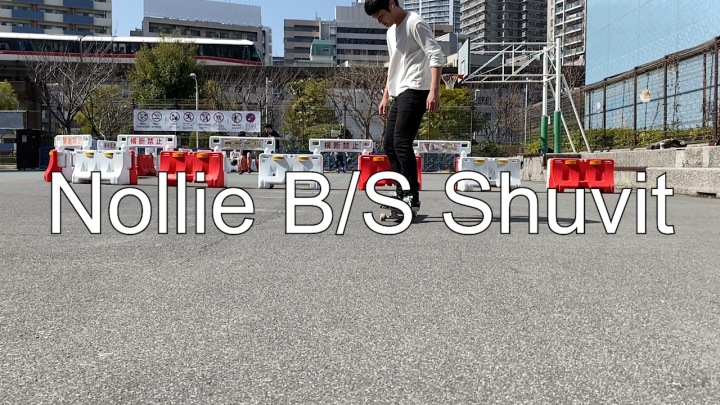
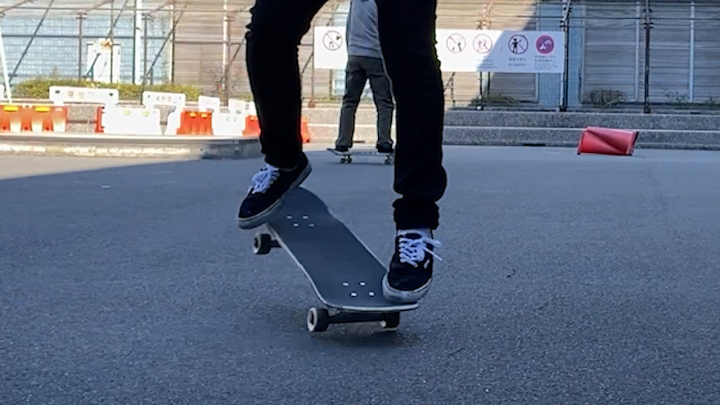
A Nollie Backside Shove-it is a trick in which the front foot pushes down the nose to rotate the board 180 degrees.
Once you become accustomed to guiding your body back over the deck, this trick not only becomes very easy but also requires remarkably little energy.
Although you may pop the trick if you choose, doing so is not necessary for completing the 180-degree rotation. All that is required is a small nudge on the nose. That alone produces a Nollie Shove-it — the type some refer to as a “phantom” Shove-it.
Note
Some skaters reserve the term “phantom” for cases where the tail should hit the ground but does not, as seen in very low Tre Flips. For the sake of clarity in this article, however, the term “Phantom Shove-it” refers to any Shove-it performed without the tail striking the ground.
What is a "Phantom" trick?
The term “phantom” is generally used when neither the tail nor the nose makes contact with the ground, or when the vertical force is so minimal that contact does not occur despite a popping motion. In this case, although the nose is pressed downward, it stops short of reaching the ground.

Simulation
Why does the board lift up?
In Nollie Shove-its, the entire board lifts from the ground even though the nose never makes contact.
We usually assume that the board rises only when we pop. Yet in this case, an entirely different mechanism appears to be at work.
A mechanism that produces upward motion without relying on a rebound from the ground. This alone makes the phenomenon remarkably intriguing from a scientific standpoint.
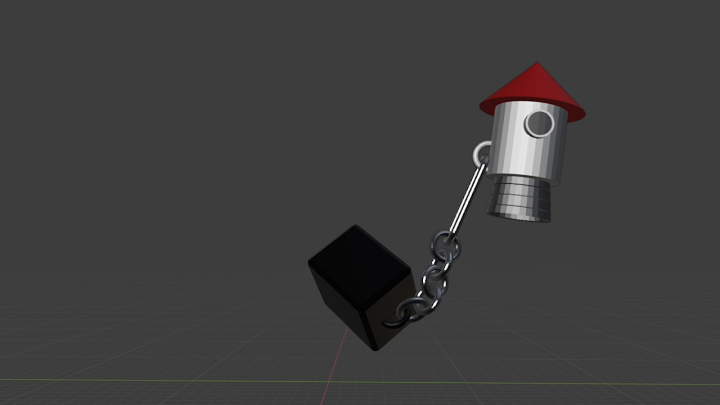
Simulation #1: The rocket test
*Please refer to the demonstration in the video.
To illustrate the concept, imagine a rocket and a box connected by a chain.
As the rocket ascends, it naturally pulls the box upward. As shown in the experiment, the box rises without generating any force of its own. It is simply carried by the rocket.
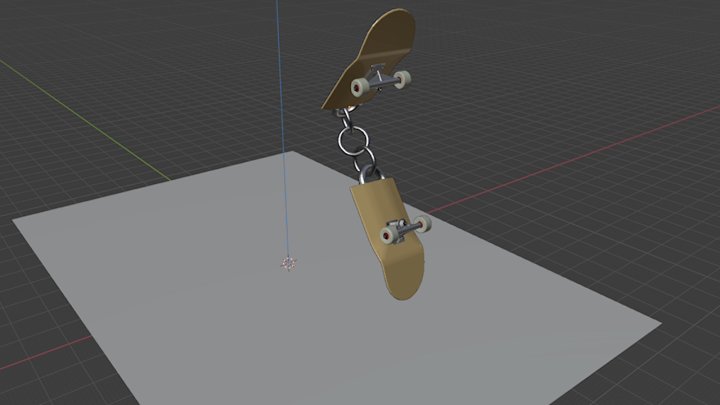
Simulation #2: The split board test
*Please refer to the demonstration in the video.
The same principle becomes clear when we repeat the experiment with separated pieces of a skateboard.
The rear truck rises despite producing no energy itself.
Application of the concept
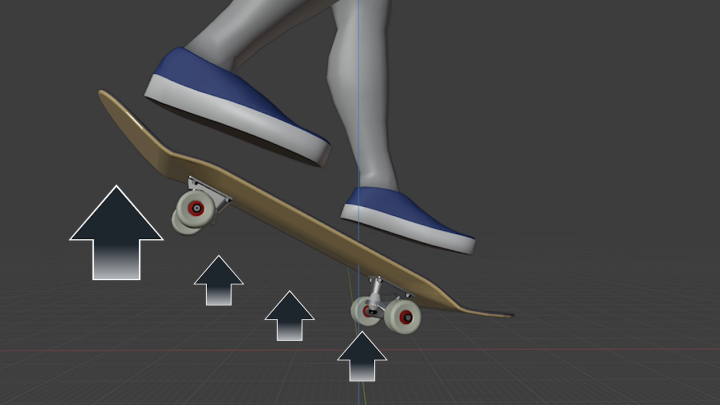
Pushing down the nose gives the tail upward momentum
When we return to the real skateboard, the underlying idea remains the same: a moving part carries the rest of the system with it.
Although a skateboard is a solid structure and cannot reproduce the exact behavior of the simulation, the same physical principles still apply.
In a Nollie BS Shove-it, pressing down the nose causes the tail to rise. This motion carries potential energy that can lift the board without requiring the nose to strike the ground.
Everything begins at the initial moment
You may wonder: “If this is true, why does nothing happen when I press down the tail while standing still?”
That observation is correct. The upward motion created by pressing down the opposite end of the board is generally too weak on its own to lift the entire board.
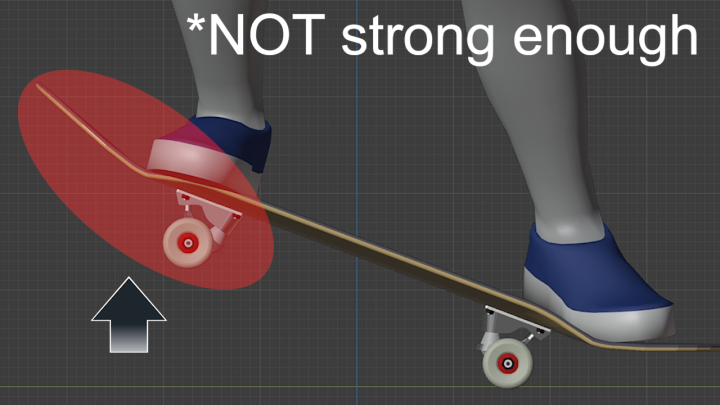
An additional upward momentum is required
So while pressing one end of the board does generate upward energy, it is insufficient on its own. Another source of upward momentum must be involved.
The key to this lies in the question: “Why are Shove-its easier in Nollie or Fakie?”
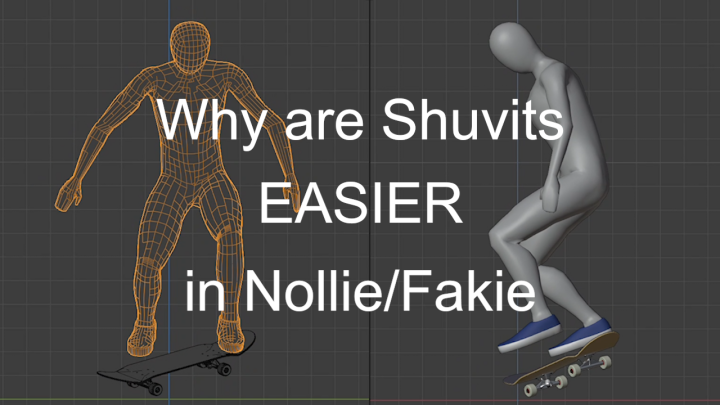
Why are Nollie/Fakie Shove-its easier?
Why does the board spin?
In a Nollie Shove-it, when I press down the nose, the tail swings outward in the direction of travel.
This rotation does not occur simply because the nose is pushed toward the toe side. Something far more interesting is happening beneath the surface.
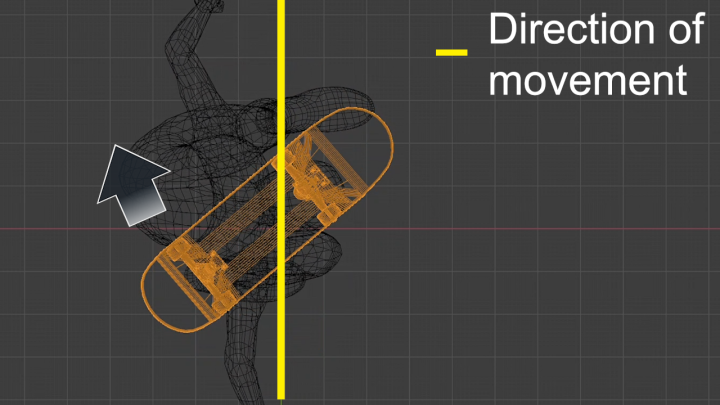
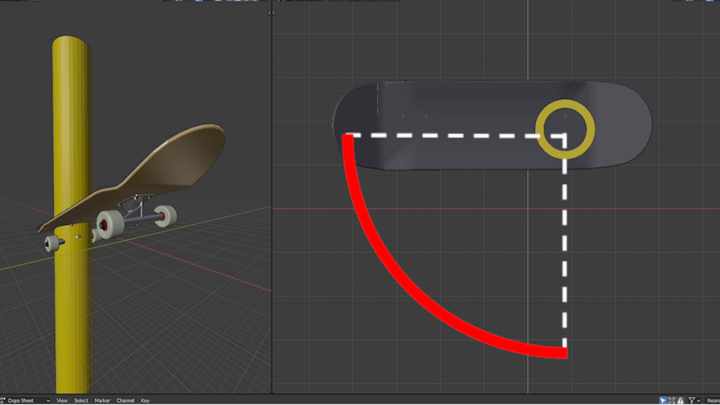
The front wheels try to stop the board
Looking closely at the front wheels, they do not leave the ground immediately after the trick begins. Instead, they remain in contact with the ground for a brief moment, even as the tail starts to swing out. During this moment, they do not stay still; they redirect their motion sideways while still touching the ground.
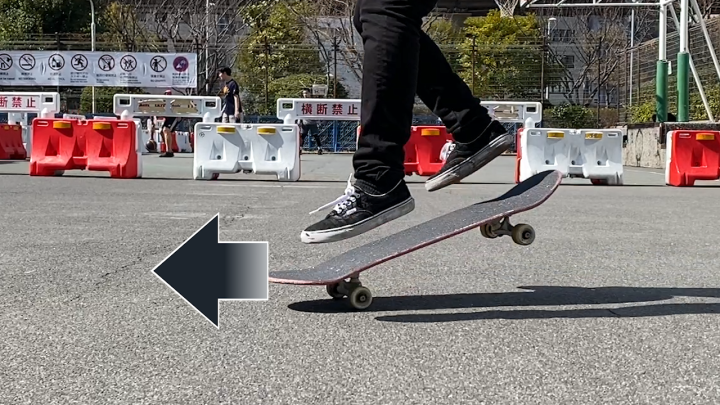
Where does the energy go?
Meanwhile, the rest of the board still carries forward momentum. With the front wheels momentarily resisting this movement, the only direction in which this energy can be redirected is around the pivot formed by the nose. This is precisely where the law of inertia comes into play.
When used effectively, this principle allows the board to rotate naturally. You barely need to force a 180-degree spin—physics does much of the work for you.
Another experiment
Car crash test
Consider a car traveling straight with a pole slightly off the center of its path. As we intuitively understand, when the car hits the pole, it spins sideways.
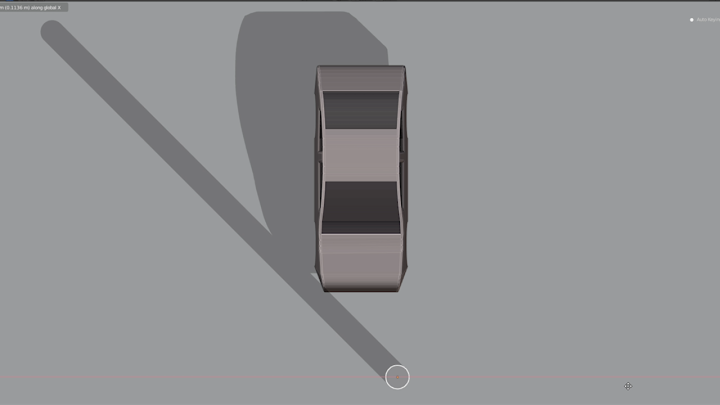
The energy needs to go somewhere
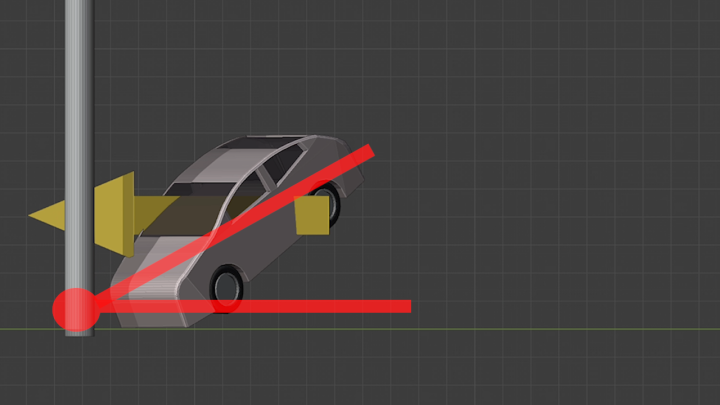
In addition to the horizontal rotation, the rear of the car also lifts. When the front of the car stops, its center of gravity still carries forward momentum, and that momentum must be redirected.
According to the law of inertia, the car attempts to maintain its original direction. However, with the pole blocking its path, the force is redirected around the pole as a fulcrum, elevating the car’s center of gravity.
Summary
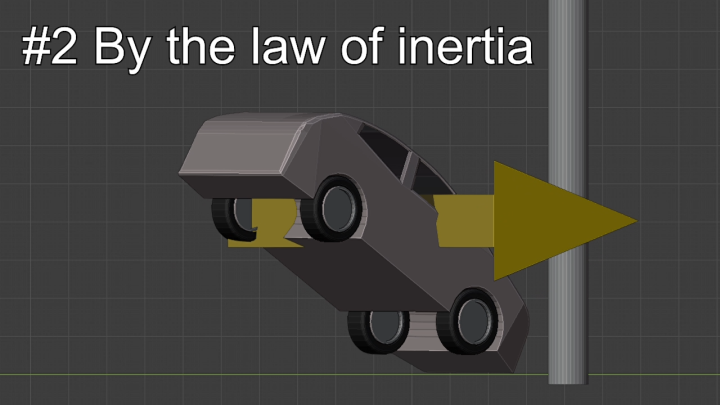
In summary, two types of upward momentum are involved:
- The momentum generated by pressing down the nose.
- The upward redirection produced by the law of inertia.
When combined, these forces create enough energy to lift the entire board.
Comparison between normal/Nollie Shove-its
You can utilize the law of inertia in Nollie
Returning to one of the earlier questions: many tricks feel easier in Nollie or Fakie because of the law of inertia.
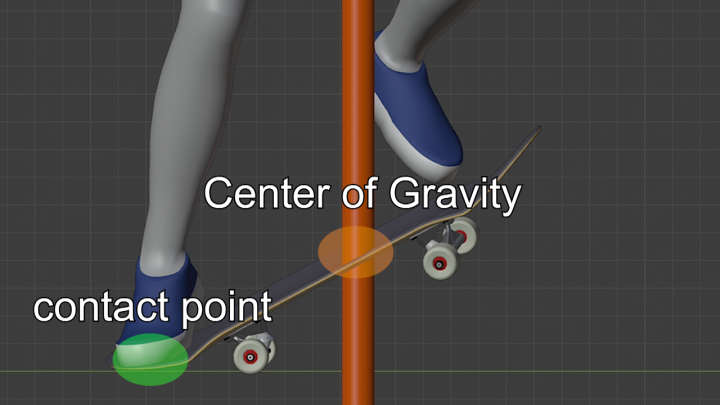
In a regular Shove-it, the point of contact with the ground lies behind the skateboard’s center of gravity. As a result, the ground contact does not halt the motion of the board nor act as a functional pivot point, making it difficult to take advantage of inertia.