Where should I look?
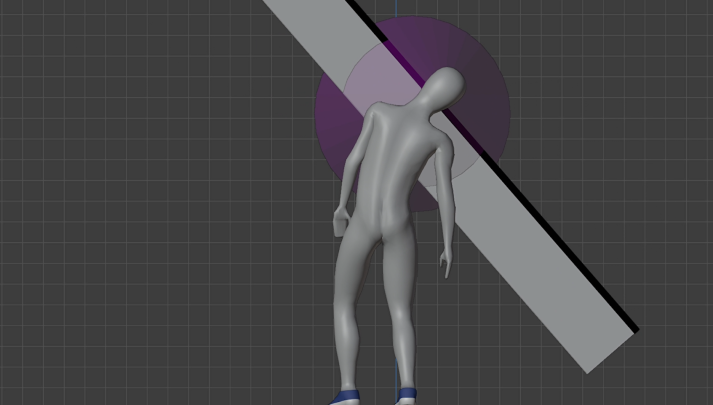
Please keep your eyes on the point where you intend to lock in, both before and after engaging with the ledge.


Your line of sight directly determines how effectively you lock in. The stability of the lock-in is strongly influenced by the direction of your gaze. In this article, we examine the scientific principles behind this effect.
Instantly discover issues with your tricks and how to fix them.
Deep analyze your motion with the cutting-edge technology.
Track your daily progress and ask questions to others.
Summary
Keep your eyes on the obstacle throughout the motion.
Select a precise spot where you intend to lock in and maintain your focus on that point as you approach. Do not look away immediately after popping; continue observing the same point even once you are already on the ledge.
Your line of sight supports natural shoulder rotation.
When you maintain your gaze on a single point after getting on the ledge, your head and shoulders naturally align toward that direction, a response consistent with ergonomic principles.
Your line of sight helps maintain the board beneath your body.
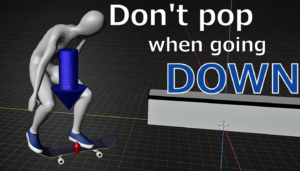
Keeping your focus fixed enables you to sense where the board should be positioned. Looking away increases the likelihood of sending the board too far from your body, causing you to miss the ledge.
Simulation











Question and Premises
Why can’t you lock in?
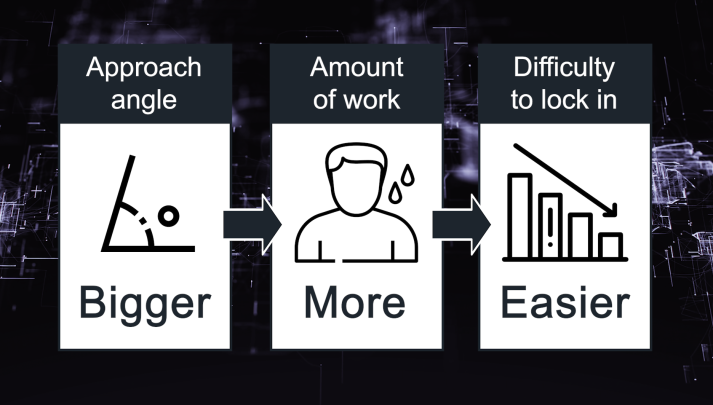
Many skaters experience this: you have no difficulty locking in a backside 50-50 when approaching an obstacle at a noticeable angle, yet the moment you reduce the angle, something suddenly feels off and you can no longer lock in.
But why does this happen? When you think about it, it is somewhat counterintuitive. From a physics standpoint, a larger approach angle should require more work, yet paradoxically it becomes easier to lock in.
When something appears to contradict the basic principles of physics, it often indicates that an important factor is being overlooked. One such factor is the line of sight.
What does it take to perform this grind?
Let us first clarify the requirements for executing this grind properly.
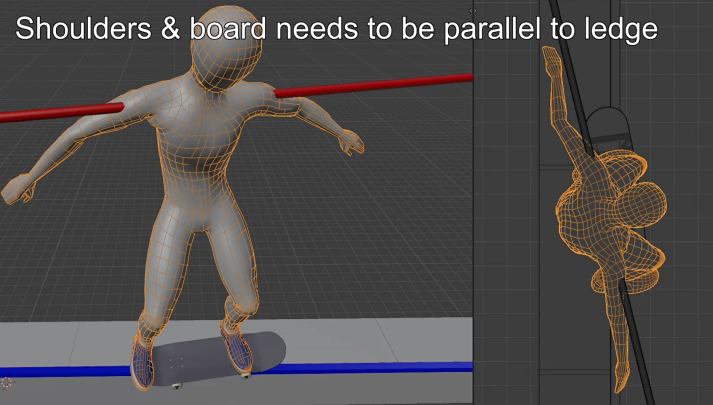
- Your shoulders and board should be parallel to the obstacle at the moment of contact.
- Your board should remain directly beneath your feet.
The line of sight significantly influences both of these elements.
Common Mistakes
Where do you tend to look?
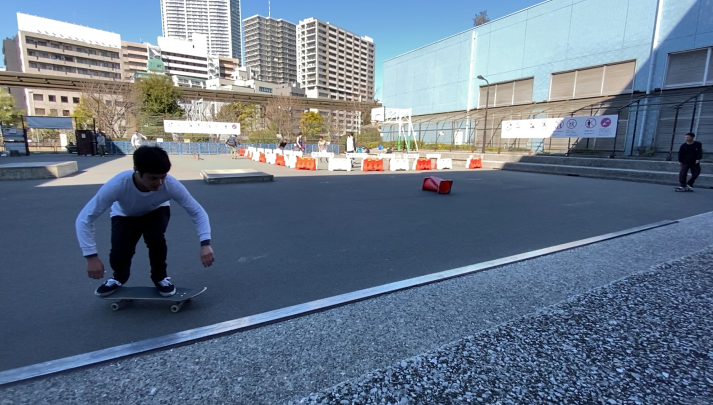
Before discussing where you should focus your gaze, let us consider where skaters commonly look during this trick. Unlike frontside 50-50s, in which it is comparatively easier to maintain visual contact with the obstacle, many skaters find it difficult to keep their eyes on a single point in backside 50-50s.
You tend to look too far ahead
Because your shoulders partially obstruct your view, your line of sight often shifts too far forward. It may seem trivial, and one might assume that the line of sight has little to do with the mechanics of the trick. However, from the perspectives of ergonomics and physics, your line of sight can be a major source of common errors.
What Happens When Your Line of Sight Is Misaligned
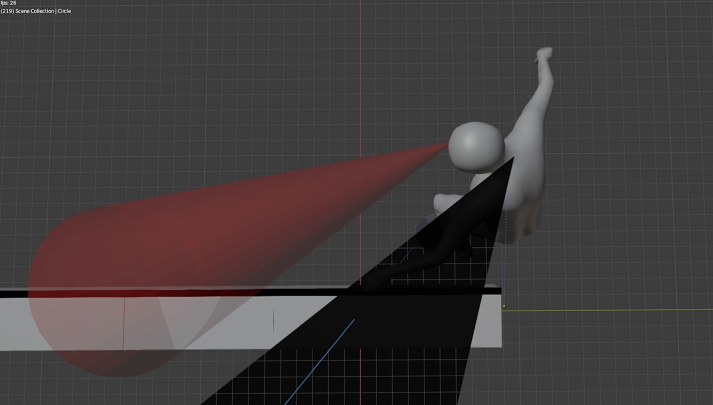
1. The line of sight influences shoulder orientation
The human body naturally attempts to face the same direction as the head. In other words, when your face turns toward a particular direction, your torso tends to align with it as well.
For example, if your gaze shifts forward while getting onto a ledge, your upper body follows that direction. This, in turn, rotates your board. This mechanism explains why many skaters unintentionally lock in on the belly of the board.
2. The line of sight influences board placement
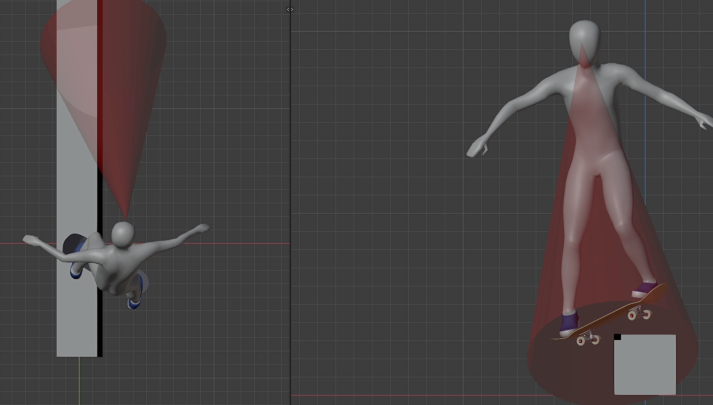
Your gaze generally dictates where you attempt to lock in, and this strongly affects where your board ends up.
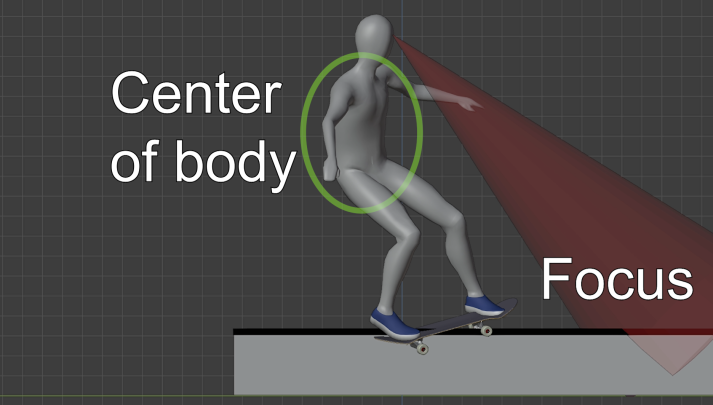
Ideally, the board should remain beneath your center of mass as you get onto the ledge. However, if you look farther ahead than necessary, your mind may already be focused on the point you are looking at, while your center of mass remains behind and cannot reach it.
The only instinctive option then is to extend your front foot in an attempt to reach that point. This often sends the board too far forward, leaving your body behind. As a result, you may end up locking in in a wheelie-like position or missing the ledge entirely.
Approaching at a Larger Angle
So why?
Given all this, why does approaching at a larger angle make it easier to lock in? In short, approaching at an angle assists you in two key ways:

1. It helps you keep your board under your body.
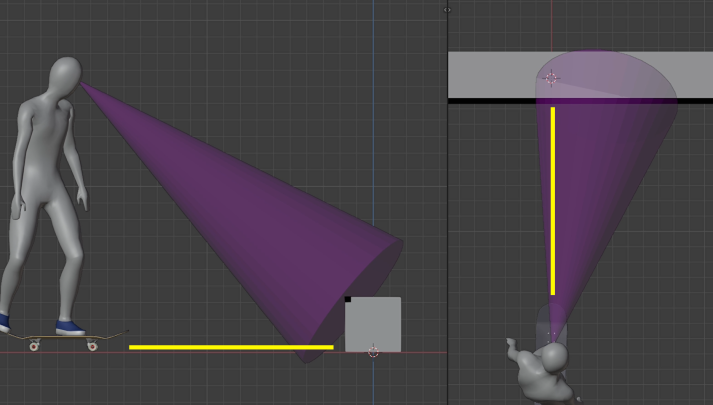
- When you approach the obstacle at an angle, you can maintain visual contact with it the entire time. This also gives you a clearer sense of the distance between you and the obstacle, making it easier to wait until the precise moment the ledge is close enough.
- After popping, with your line of sight directed downward toward the obstacle, all you need to do is bring the board back underneath your feet.
- Once you have the board centered beneath you, you will no longer feel the need to push it any farther forward.
- By keeping the board under your body, you avoid locking in in a wheelie-like position or simply missing the ledge altogether.
2. It helps you align your shoulders with the ledge.
- Imagine looking at a specific point on a moving train while you are standing still. To keep your gaze fixed on that point, you do not move only your eyes—your entire face naturally follows.
- A similar phenomenon occurs in backside 50-50s. With a larger approach angle, it becomes easier to maintain your focus on a single point even as you get onto the ledge. As your shoulders begin to rotate during the lock-in, your line of sight, face, and shoulders follow the motion of the ledge. Put simply: if the ledge appears to rotate relative to your movement, your head and shoulders must rotate in the same direction to keep your gaze fixed. In this manner, maintaining visual focus naturally turns your face and shoulders without conscious effort. Conversely, if your gaze wanders, your body rotation stops. Therefore, keep your focus on the same spot until your body becomes fully parallel to the ledge.