Why can you push the tail forward if your knee cannot bend that way?
At a glance, it seems impossible. The knee bends backward, not forward, so you should not be able to produce enough force to drive the tail ahead of you.
There is, however, a clear scientific explanation.

Summary
Shift your weight to the heel side before popping
Positioning your weight on the heel side allows you to drive the tail forward while naturally guiding your landing toward the heel side.
Your board lands around the 7–8 o’clock direction
When the tail is pushed forward, the heel-side wheel of the rear truck acts as a pivot. As a result, the board swings outward toward the heel side.
Maintain a fixed shoulder angle
Maintain a steady shoulder angle without changing it mid-air. It does not necessarily need to be parallel to the deck.
Simulation
Select the icon to launch the 3D simulation.












Physics
Push the tail forward and pop it downward
Before discussing the technique, let us examine the physics that makes this trick possible.
To generate rotation, you must apply horizontal force to the tail. In addition to this sideways force, you also need to pop the tail downward so it strikes the ground.
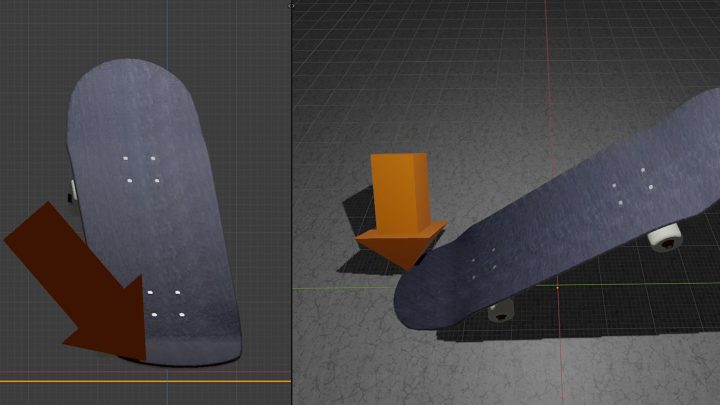
To understand what actually happens, let us observe the effect of these forces in a physics simulator.
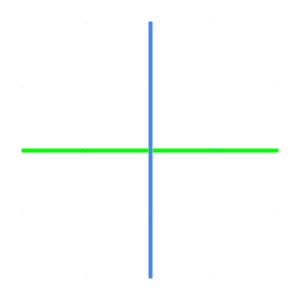
Here, a skateboard is placed on a directional guide resembling a large clock face. A white ball is then dropped onto the heel-side pocket of the board.
The green line shows the ball’s horizontal position, while the black line shows its trajectory.
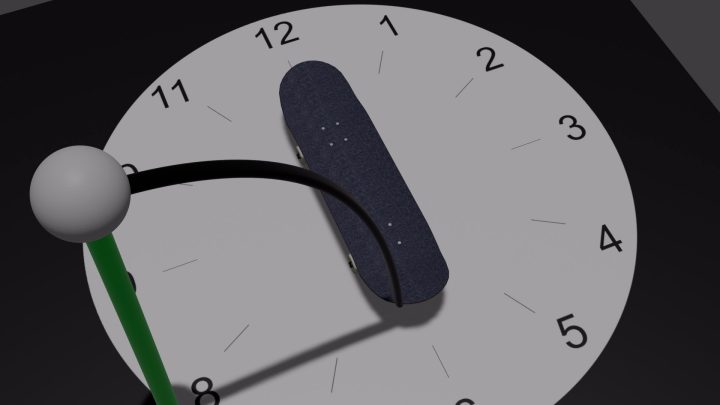
The simulation shows that the board tends to land at approximately the 7–8 o’clock direction from its starting point.

When the tail is popped diagonally downward, the heel-side wheel of the rear truck acts as a pivot.
Because the front section of the board has greater mass, the board swings outward and lands around the 7 o’clock direction.

In summary, the physics indicates two essential requirements:
- Apply both a horizontal spin and a downward pop to the tail.
- Shift your body toward the heel side by the time the board completes its rotation.
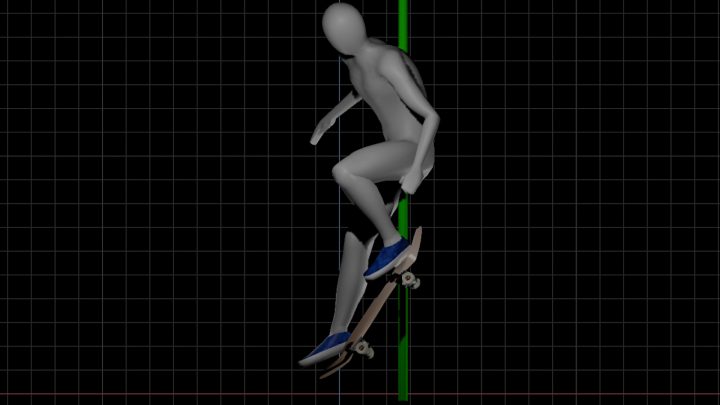
Execution
How to push the tail forward
The central question is how to apply forward force when the knee cannot bend in that direction.
In essence, placing your weight on the heel side before popping allows you both to “drive the tail forward” and to “shift your body toward the heel side.” Let us examine this in more detail.
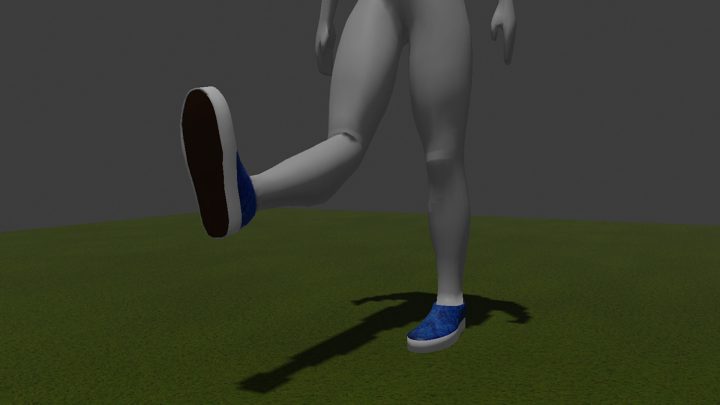
How heel-side weight affects your body’s trajectory
Imagine your center of mass positioned on the heel side while you jump straight upward.
Because your center of mass and the point of action (your back foot) are offset, your body naturally travels toward the heel side without any intentional backward movement.
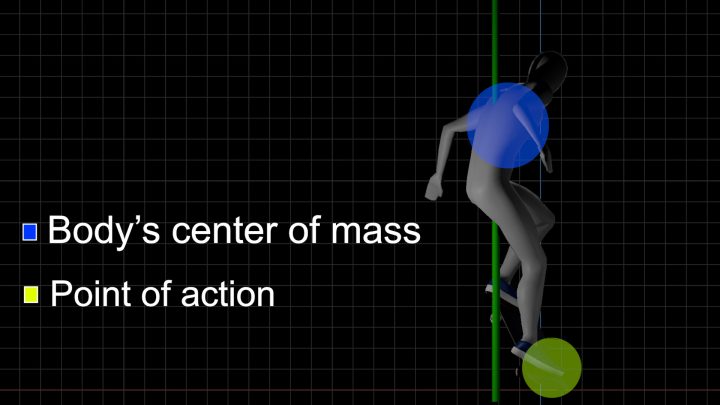
How heel-side weight affects your board’s trajectory
At the same time, the same offset causes the tail to be pushed forward.
The forward drive is a natural result of placing weight on the heel side and popping the tail directly downward.

Foot placement
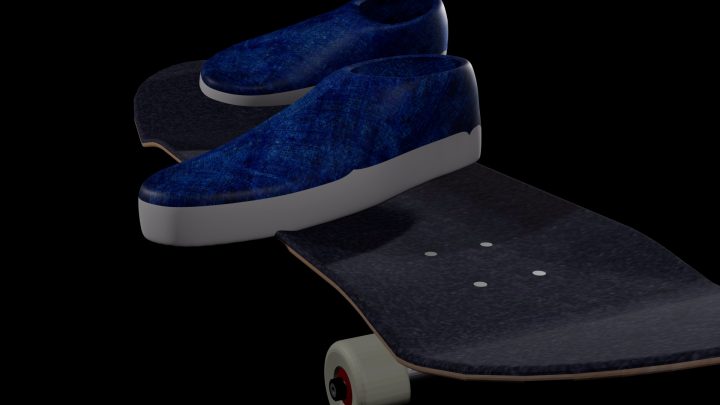
Back foot on the heel side, front foot on the toe side
As discussed earlier, the heel-side wheel of the rear truck functions as a pivot.
To engage this pivot more effectively, place your back foot closer to the heel-side pocket.
With your back foot on the heel side, positioning your front foot with the toe hanging out helps maintain your center of mass over the board.
Practice
It is advisable to practice while rolling. This makes it easier to avoid the board striking your shin.
Move slowly, set your foot placement as described above, shift your weight toward the 7 o’clock direction, and pop the tail.
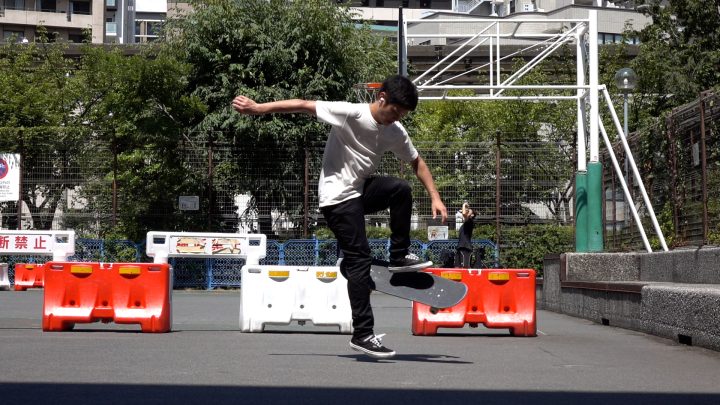
At the beginning, there is no need to land on the board. Focus solely on producing a clean spin.
Practice the spinning motion to understand how far you must shift your weight backward.
Remember, your weight must be placed toward the 7 o’clock direction. Experiment with slight variations—toward the back foot or further toward the heel side—to find what works best.

Shoulders
Let us discuss one more important element: the shoulders.
In a Frontside Pop Shove-it, avoid swinging your shoulders, unlike in a Frontside 180.
For a Frontside 180, the shoulder rotation directly contributes to the turn.
However, in a Frontside Pop Shove-it, the board rotates due to the offset between your center of mass and the point of action.
Therefore, swinging your shoulders is unnecessary and may even disrupt your balance.
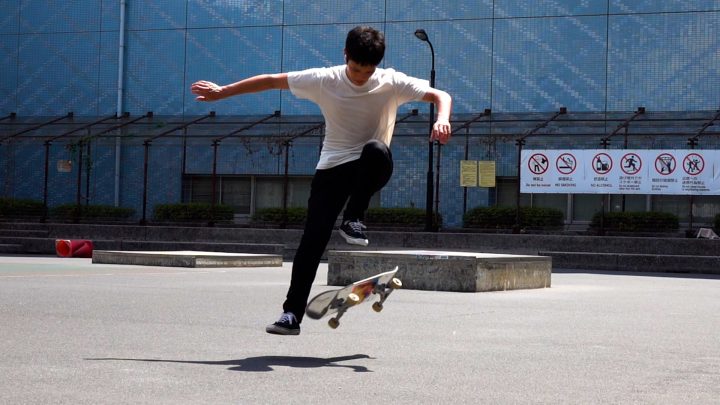
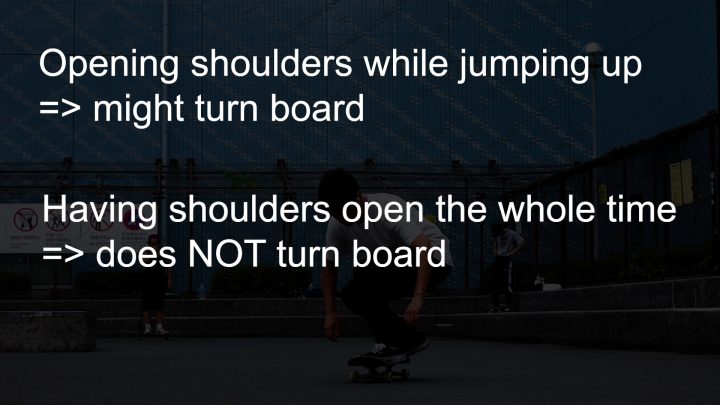
Do you really need to keep your shoulders parallel to the board?
It is often said that your shoulders should remain parallel to the board, but I suggest otherwise.
Although opening your shoulders during takeoff can add a small amount of spin, keeping them at a fixed angle throughout the motion does not create additional rotation.
Position your shoulders in a comfortable manner and avoid changing their angle while you rise into the jump.