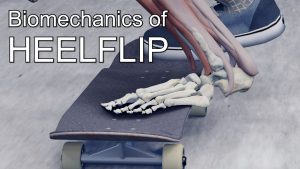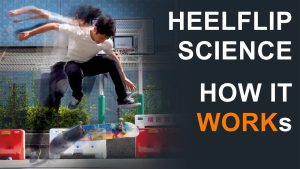
If you place the board on the ground and kick it, it flips incredibly easily, but the moment you actually try it, it doesn’t flip nymore. Indeed, it does look like you have to flick diagonally upward, but you’ll be just stroking the surface of the board by doing so.
According to the laws of physics, to flip, the board needs a downward force. The secret is, even if you flick down, as long as your knee continues to rise, your flick always goes upward. In this article, I will scientifically explain the common problems with the Heelflips and how to fix them.
Physics Behind Heelflip
In order to flip the board, the direction and strength of the flick are extremely important. As I explained in the Kickflip video, every object, including a skateboard, has three rotational axes: X, Y, and Z.

To rotate it, you need to apply a force that causes it to rotate around the axis you want. If we consider the Heelflip as a rotation around the yellow Y-axis, to rotate the board most efficiently, you need to apply a force perpendicular to the Y-axis. So, in this case, flicking it downward is the most efficient way to flip it.
Now let's think about the strength of that force. When the board is stationary, the force required to flip it is represented by the size of the blue arrow.

Next, let's assume the board is moving with the force of the red arrow. In this case, even with a gentle push on the nose, it combines with the nose's energy to rise and generates the same effective force as when it was stationary. Unlike when flipping the board while stationary, with momentum, a gentle, quick, compact push is enough to flip it. And you don’t need to Ninja kick, which causes a lot of problems that I’ll explain in a minute.
Understanding how little force you need to flip the board is so important. You can get a real sense of how much force the board needs to flip by trying to flick it while stepping off the board. You'll realize the board flips even with a gentle flick.
Also, in an actual Heelflip, the force applied by the flick is not perfectly perpendicular to the Y-axis—it is somewhat angled diagonally forward, and you’d flick off the nose. Because of this, the board also rotates around the X-axis, and the nose drops, the tail rises, and the board levels out horizontally.
The Pitfall of the Expression to Flick Upward
From a physics perspective, applying a downward force should flip the board more effectively. However, they have often said that it's better to flick diagonally upward in traditional tutorials. And when you actually look at the real motion, you can see that the front foot indeed moves diagonally upward. So why does this "difference between theory and reality" occur? Intuitively, by flicking upward, you can tell you’d be just stroking the surface of the board, can’t you? Are we missing something that somehow flips the board by flicking upward?

No, we are not. In reality, your front foot "moves upward while applying a downward force." In order to understand what this means, try imagining yourself flicking downward. You may use either your toe or the side of the heel, as you have to adjust your flick based on your body structure. What matters is what they have in common; the flick directs downward, generating the energy needed to flip the board.

Next, let's say you also jump. Your body rises, and so does the front knee. Notice how the board rises WITH the front foot.
Now, combine these movements, and magic happens. The front foot swings downward and provides energy to flip the board, but from the perspective of the height above the ground, it goes up. The point is to think of these things separately: the toe swinging downward as part of the flicking motion, and the knee rising as part of the jumping motion. As a result, the front foot travels upward while flicking downward.
The same thing can be said when you use the side of the heel. It becomes more like a knee-extending motion. Either way, as your body rises, your front foot gains height seen from the ground while exerting downward energy into the board. In other words, no matter how strongly you flick down, as long as your knee goes up, the front foot goes upward.
The most important thing is that this is NOT flicking upward. Just because the front foot appears to move upward, it does not mean you have to flick upward, which never flips the board. Let’s see what it does in a minute.

How-to Generate Downward Force
As a basic principle, you must avoid kicking your front foot straight down; otherwise, it would reach the ground first.
With that in mind, there are two main approaches. When using the toe, let the nose push your foot back, then swing it through. This creates a downward force similar to that of a construction crane.
When using the side of your heel, press your foot diagonally down and forward, and the ankle naturally flexes and flicks off the nose. Try not to kick downward too much, or you won’t be able to keep your front foot over the board.
So, which method should you choose? It depends on your preference and body structure. People sometimes say you should have your front foot at 90 degrees to the board with the toe hanging out. You should do so if you can squat while keeping your heels on the ground. In this case, you should be able to flick off the heel.

On the contrary, duck-footed people like me often can’t squat with their heels on the ground when their toes are pointing forward. In that case, you should point your toe more forward and use it to flick.

Reason The Board Stops Flipping
As mentioned earlier, it is mainly because you are flicking upward on purpose. Let’s consider the case where you use your toe. Suppose the flicking motion itself goes upward. At this point, you can already imagine that the rotational force applied to the board becomes extremely small. On top of that, a jumping motion is added. Flicking upward causes your body axis to lean back toward the back foot. When these are combined, the front foot ends up cutting through the air without applying the force the board needs to flip.
The board is down below, but the area where the flick exerts its maximum strength is up around your hip. That’s why you must avoid trying to flick upward on purpose and get used to the feeling of flicking down.

Try simulating how you use your front foot while standing still. You can track your movement with Whythetrick's motion analyser. If the trajectory of your front foot is angled diagonally upward, that already means you are not doing it right. First, practice the flicking motion so that you can apply force downward.

Timing of Flick
Let’s also talk about the timing. Remember, the board can flip easily if you can utilise the difference in speed between the nose and the front foot. Plus, in order for your front foot to be able to flick, the board needs an adequate angle. So, to flip the board, lift your foot and knee first; only then can you flick.
The problem is that the more you focus on flipping the board, the earlier you tend to start the motion. If you do so, your front foot blocks the nose’s movement, and the board's angle can no longer increase. Then, no matter how strong your flick is, it can’t transmit enough energy to the board. In this position, it’s not angled enough, and as the nose stays low, your flick becomes horizontal and can’t transmit a downward force.
Moreover, during this process, your body continues to rise, but only the board loses the force to rise. And your front foot won’t be able to even stay in contact with the board.
Even if your front foot could reach the board, the force that raises the nose, which helps you flip the board more efficiently, is already almost gone. If the nose doesn’t have that force, you won't be able to flip the board with the same flicking force. Compared to flicking while the nose has momentum, the effective force applied to the board becomes smaller. And that's why you end up landing on your board upside-down or Primo. After all, it flips more easily when the nose has energy to rise. And trying NOT to suppress its motion is important.
Common Problems: Rocket Flip
A rocket flip or creditcarding yourself is the most common example. If you try to flick immediately after the pop and your front foot shifts toward the toe side, the nose will rise straight up as if it is stabbing into your crotch.

To avoid this, direct the flick more forward and receive the push from the nose before flicking.
Common Problems: Low Heelflip
Low Heelflips are caused by the same timing issue. Ideally, you want to keep your lower leg relaxed and let the nose come up. Focusing too much on flicking can make you flick too early, creating unnecessary tension on the front leg. The nose’s energy will be consumed by the front leg’s tension, and you won’t be able to bring it higher anymore.
To make it higher, lift your knee and let the nose come closer to you. Then flick only after the board's angle has increased enough.
Common Problems: Board Shoots Out Forward
And the early flicking causes the board shoot out forward, too. When you try to flick before lifting your knee, you end up pushing the board forward, and it flies off somewhere.
The solution is the same. Let the nose come closer, then flick.
Practice Method
While timing is crucial, and it’s easy to say "you should wait before you flick," it's only natural that the more you want to flip the board, the more tension your leg will automatically take on, making it hard to keep it relaxed. In order to get used to a movement that goes against your intuition like this, try the following practice.
- Pop the tail
- Step off the board
- Lift your knee
- Let the nose push your front foot back
The goal is to correct the habit of flicking immediately after the pop. In this practice, make sure to avoid flicking too early and let the nose come closer.
You should practice the flicking motion once you get used to it. The motion of Heelflips can be misleading, as it appears you have to extend your knee, but, as I mentioned earlier, the force required to flip the board is very small, and a gentle flick is enough. Think of it like this: The knee extension is a result of swinging out your front foot partway forward because it can’t stop suddenly, much like a construction crane. The role of the flick ends right after passing through the nose, and you don’t have to flick like a Ninja kick. So, get used to flipping the board with as little energy as possible.
Remember: the harder you try to flick, the more tension you tend to put on your leg, which blocks the nose from coming up in vain. It's important to keep in mind that you don’t have to flick so hard and keep your leg relaxed, so you can flick after letting the nose come up.

Summary
- In order to flip the board, you need to apply a force around its rotational axis, which, in a Heelflip, is generally diagonally downward.
- To generate such force, you need to lift your front knee and flick downward by using either your toe or the heel.
- The downward flick gives the board enough energy to flip, but because your knee rises, from the standpoint of the height from the ground, your front foot always goes up during the flick.
- Separate the motion of jumping and flicking, so you can learn each process one by one.
- The most important thing is to truly understand how easily the board flips and to avoid putting unnecessary tension into your leg.