Why does my kickflip rotate so slowly?
Do not pop excessively hard. When the nose carries too much energy, initiating the flick becomes more difficult.


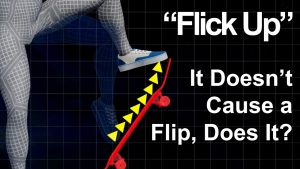
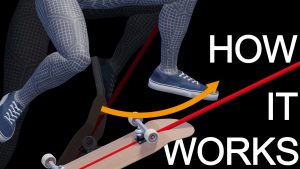
The pop is one of the most overlooked yet most critical elements of any skateboard trick. It is essential to understand the distinction between jumping and popping in order to avoid overpopping. Excess force transferred into the nose makes it harder to initiate a clean flick. This article examines the mechanics behind this phenomenon.
Instantly discover issues with your tricks and how to fix them.
Deep analyze your motion with the cutting-edge technology.
Track your daily progress and ask questions to others.
Summary
Pop only as hard as necessary to bring the nose to your front foot.
Snap the tail and guide the nose upward so your front foot can remain in contact with the deck. When the nose carries excessive momentum due to an overly strong pop, the force of the flick becomes comparatively weaker, making the rotation slower.
Raise your body first, then pop lightly.
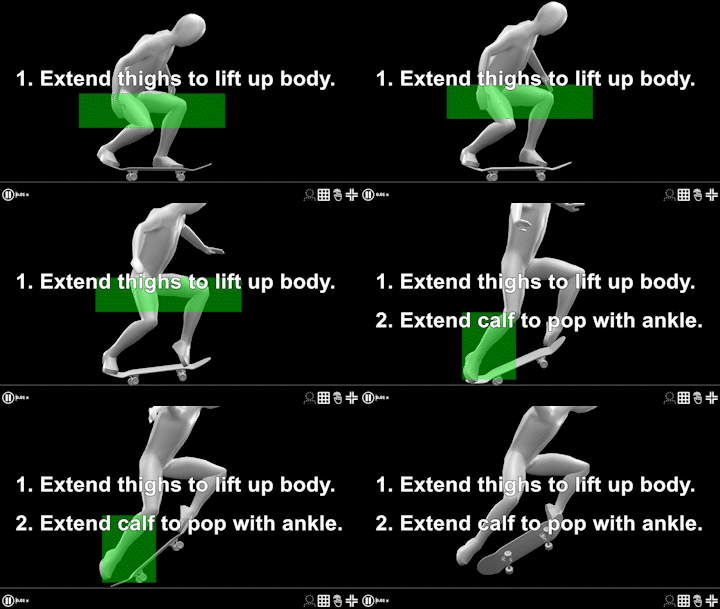
Your thighs elevate your body, and your calves perform the pop. By lifting your center of gravity before popping, the tail can be snapped with significantly less force.
Avoid overpopping.
Pop just firmly enough so that the nose naturally loses its momentum near the peak of its trajectory. If the nose still carries surplus momentum beyond that point, the flick becomes unnecessarily difficult to execute cleanly.
Simulation












Common Mistakes
Your board may flip slowly if you try too hard to rise away from it.
You pop the tail for two primary purposes:
- To lift your body into the air.
- To raise the nose so it reaches your front foot.
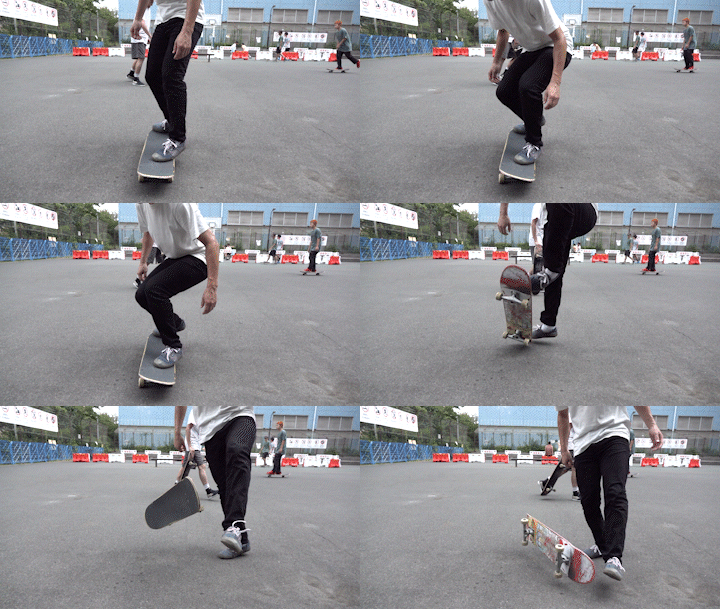
A common issue arises when skaters try to pop harder because they feel the board flips too slowly and believe they must stay in the air longer to avoid landing primo or upside down. It may seem counterintuitive, but attempting to jump higher can actually cause the board to flip more slowly.

What happens when you pop?
A skateboard behaves as a single rigid object. When force is applied to one side (the tail), the opposite side (the nose) responds accordingly.
In essence, the harder you pop, the more energy the nose receives. As a result, the strength of your pop directly dictates how powerful your flick must be.

How to Pop Effectively
Pop lightly so the nose loses excess momentum.
In the previous analysis, we demonstrated that only about 3 kg of force—an amount easily generated by a finger—is sufficient to flip a skateboard. Human legs can easily produce far more energy than needed.
However, this applies only when the nose is nearly motionless. This leads to the following considerations:
- When the tail is popped too forcefully, the nose retains excessive upward energy, making it difficult for the front foot to initiate an effective flick. The board may feel heavy to flick because the upward momentum of the nose exceeds the force applied by your flick.
- The upward momentum of the nose needs to decrease sufficiently by the time it reaches the position where your front foot begins the flick; this is the condition under which the nose can be guided smoothly to your front foot.

Lift your body with your thighs, and pop the tail with your back calf.
Understanding the distinct roles of the thighs and calves is essential for popping without overpopping.
Role of the thighs
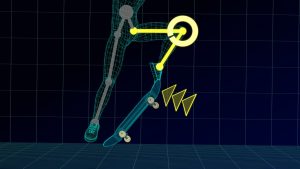
Use your thighs to elevate your body weight—not to generate the pop itself. Extending the thighs before snapping the tail reduces the load pressing down on the board. When your body weight is already rising, the tail can be snapped with significantly less force.
Role of the back calf
Use your back calf specifically to strike the tail. The calf alone cannot lift your body and must work in coordination with the thighs.
Allow your thighs to raise your center of gravity first, and pop only after that upward motion has begun.
Practice
Practice flicking while stepping off your board.
The same training method introduced in “How to Flick” applies here as well.
- Pop lightly—no excessive force is required.
- Step off the board by jumping slightly toward the heel side.
- Keep the front foot on the deck and slide it upward.
- Flick gently, paying close attention to the point where the flick should end.