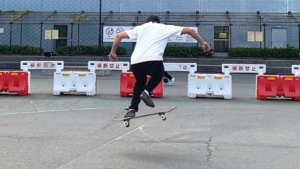
In pop shove-its, spinning the board is not the most difficult part; the real challenge lies in landing back on your deck. The board may fly away, flip after you think you have caught it, overspin, or cause your back foot to miss the deck entirely. In this article, after reviewing the basic physics of pop shove-its, we will explore the scientific reasons behind these issues.

Summary
The board lands in front of you.
From a physics perspective, the board naturally travels toward the toe side.
Shift your weight toward the toe side before jumping
It is difficult to jump upward while simultaneously moving forward. Instead, shift your weight toward your toe side before taking off. By doing so, you will naturally move slightly toward the toe side even when you intend to jump straight upward.
Simulation












Where does the board land?
According to physics, it lands on the toe side.
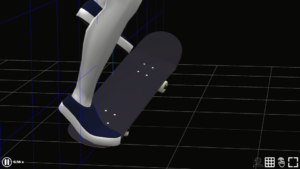
Let us begin by examining where the board actually travels during a pop shove-it. As you initiate the pop, one of the wheels acts as a pivot and guides the board toward the toe side. Shortly after, the tail makes contact with the ground, reinforcing this direction of movement.
In practice, the board consistently lands on the toe side, and this holds true for both pop shove-its and regular shove-its.
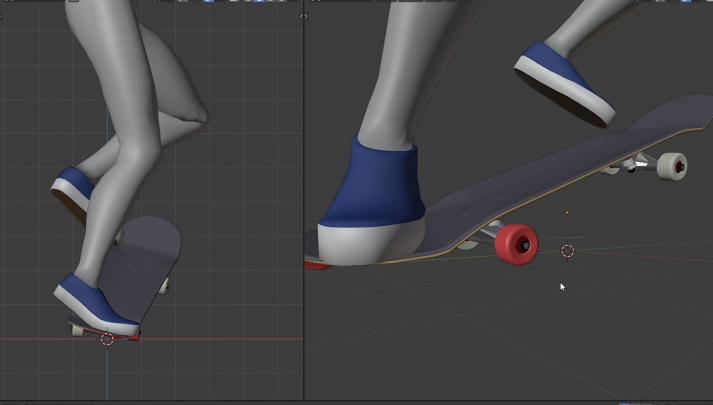
How to land
So the board lands in front. Where does your body go?
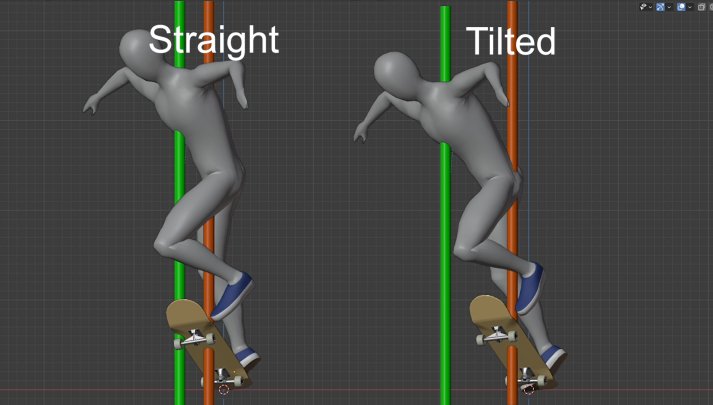
This may vary depending on personal preference, but try the following approach: Shift your weight diagonally forward BEFORE popping. By doing so, your body will already be positioned above the area where the board will travel after the pop. In this illustration, the model’s weight is shown in lime green.
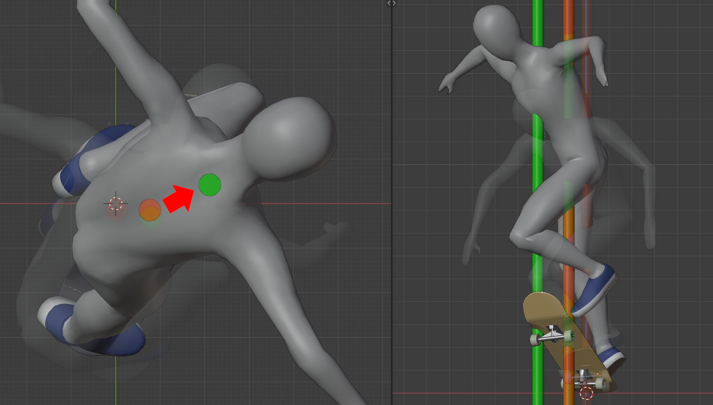
You can move forward by simply jumping straight up
By shifting your weight beforehand, you can focus entirely on popping strongly without consciously trying to jump forward, because your body weight is already positioned slightly ahead of your back toe.
In practice, when you attempt to pop straight downward, you will naturally push the board toward the heel side while your body travels toward the toe side.
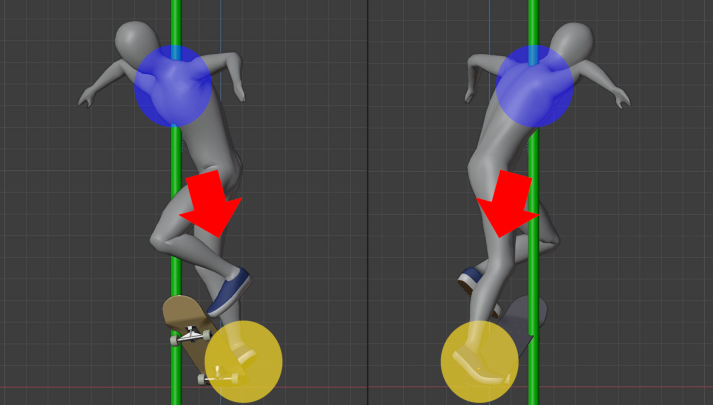
Adjust how far forward you shift
Since your body continues to move in the same direction while in the air, avoid shifting your weight all the way to the final landing point before popping.
In my own case, it appears that I shift my weight approximately 20 cm diagonally forward before initiating the pop.
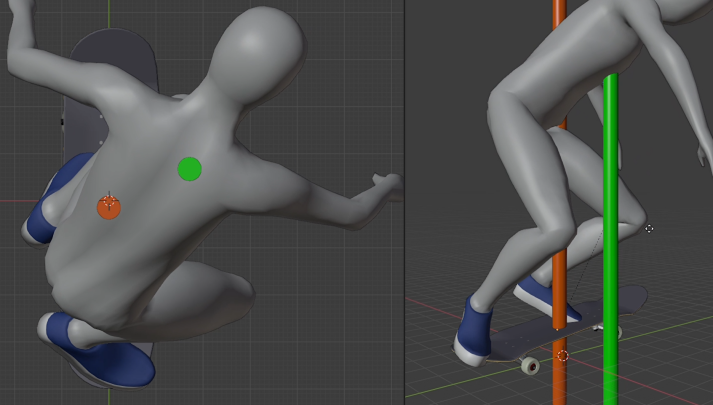
What could go wrong?
Cause
One common issue is the so-called "catch and flip" problem, which occurs when your center of gravity is not located above the board. Even if you believe you have caught the board, the misalignment between your body’s center of gravity and the board’s center causes the board to flip or escape from beneath you.
If this happens, try shifting your weight slightly further toward the toe side.

Too much of a good thing
However, if you shift your weight too aggressively, the board may overspin. With more weight placed on the toe side, it becomes increasingly difficult to pop straight downward, making it easier to unintentionally scoop the tail and create excessive rotation.