What role does wheel size actually play?
Wheel size is commonly said to affect speed, acceleration, and the ease of performing tricks. In this article, we examine these claims based on physical principles, using a physics engine for controlled comparison.
Instantly discover issues with your tricks and how to fix them.
Deep analyze your motion with the cutting-edge technology.

Track your daily progress and ask questions to others.
Summary
Larger wheels are heavier, but the effect is minimal
A 3 mm difference in diameter results in about 48 grams of weight difference for a set of four wheels. This is roughly the weight of an egg, meaning the impact on flip tricks is negligible in terms of mass alone. The distribution of mass—its position relative to the axis of rotation—plays a far more important role than the increase in total weight.
Larger wheels reduce rolling resistance
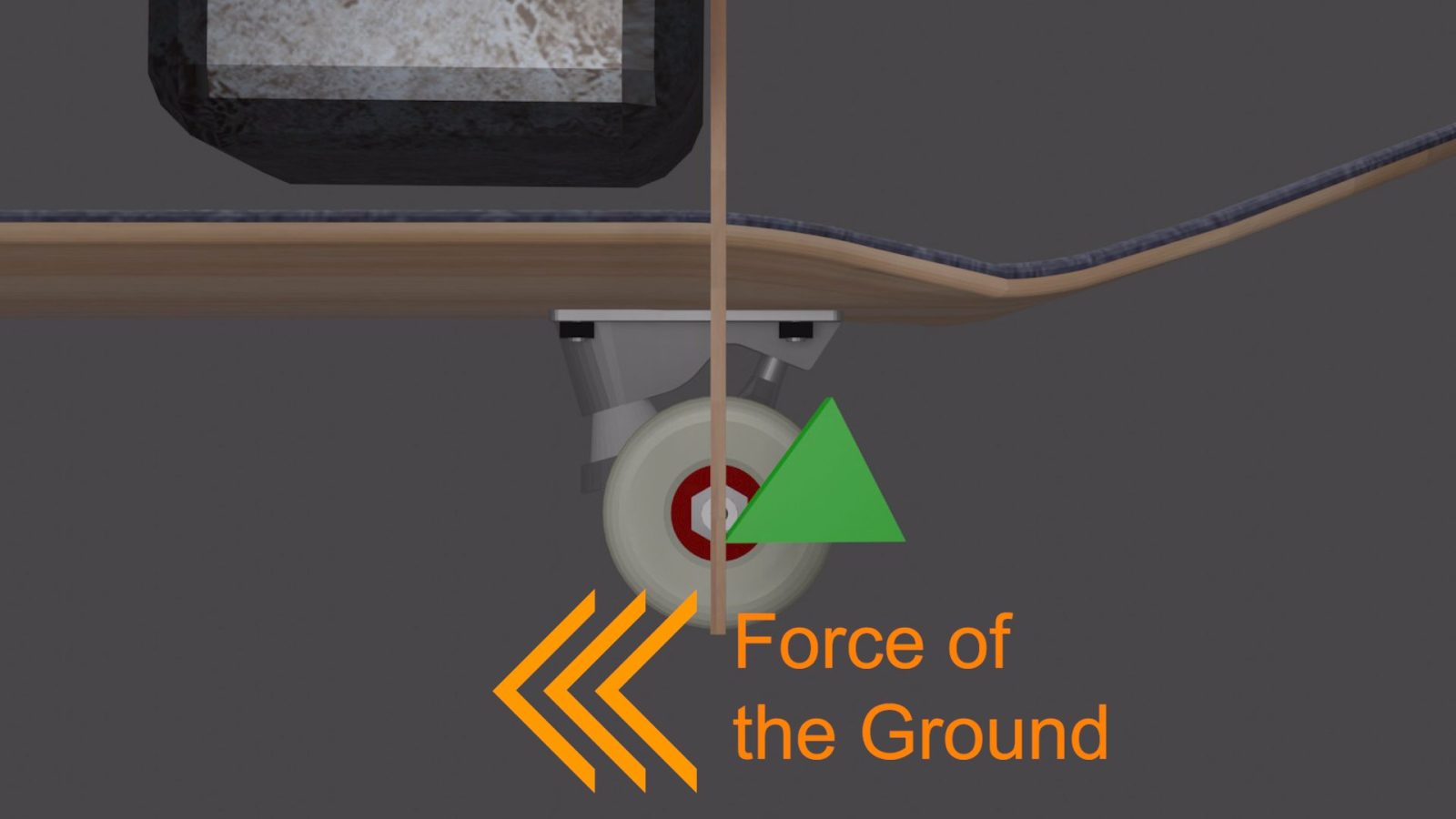
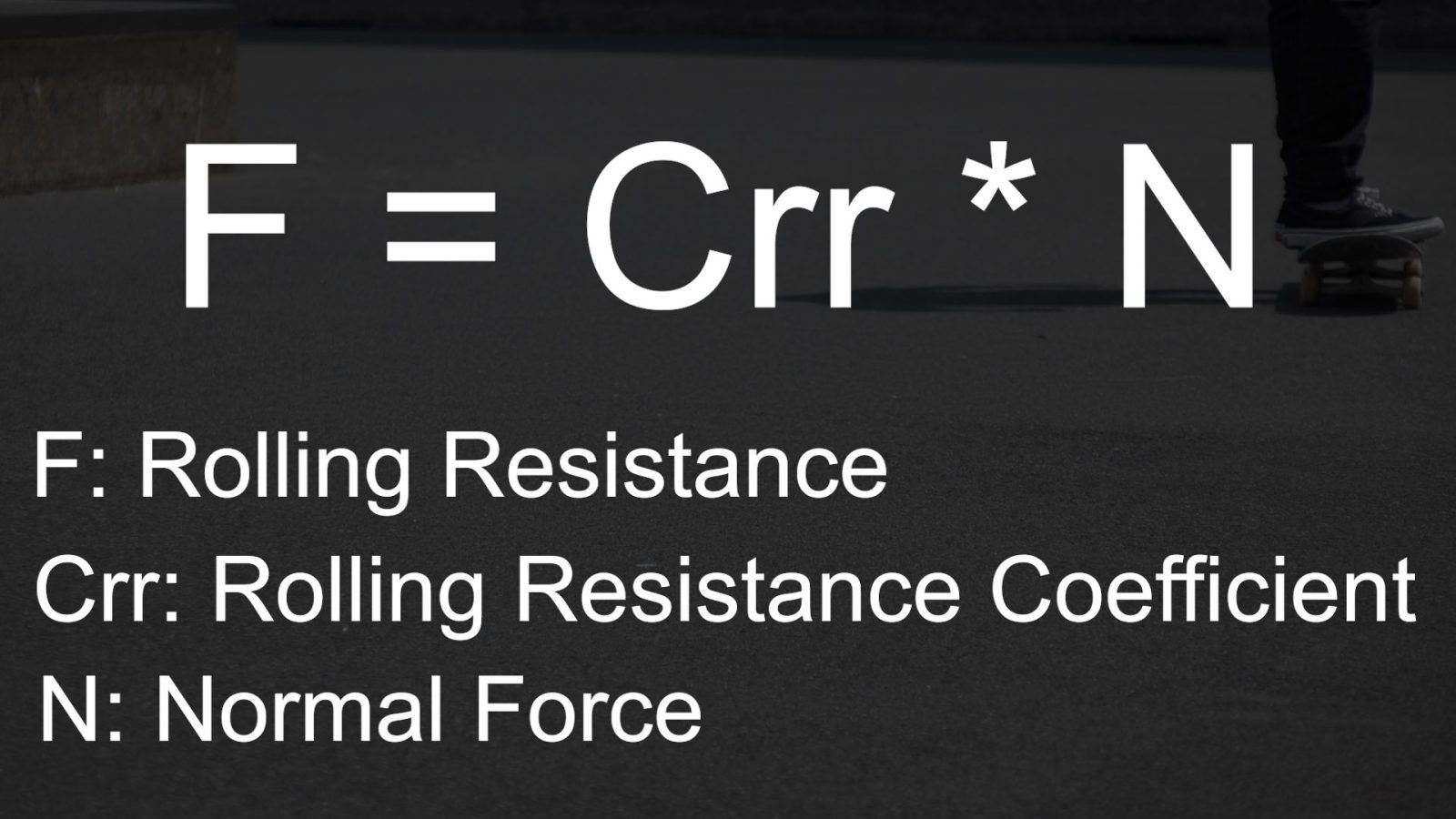
Rolling resistance is proportional to the load and inversely proportional to wheel diameter. Therefore, larger wheels roll more efficiently because the effective deformation at the contact patch becomes proportionally smaller.
Simulation












The weight and its impact on tricks
Basic figures
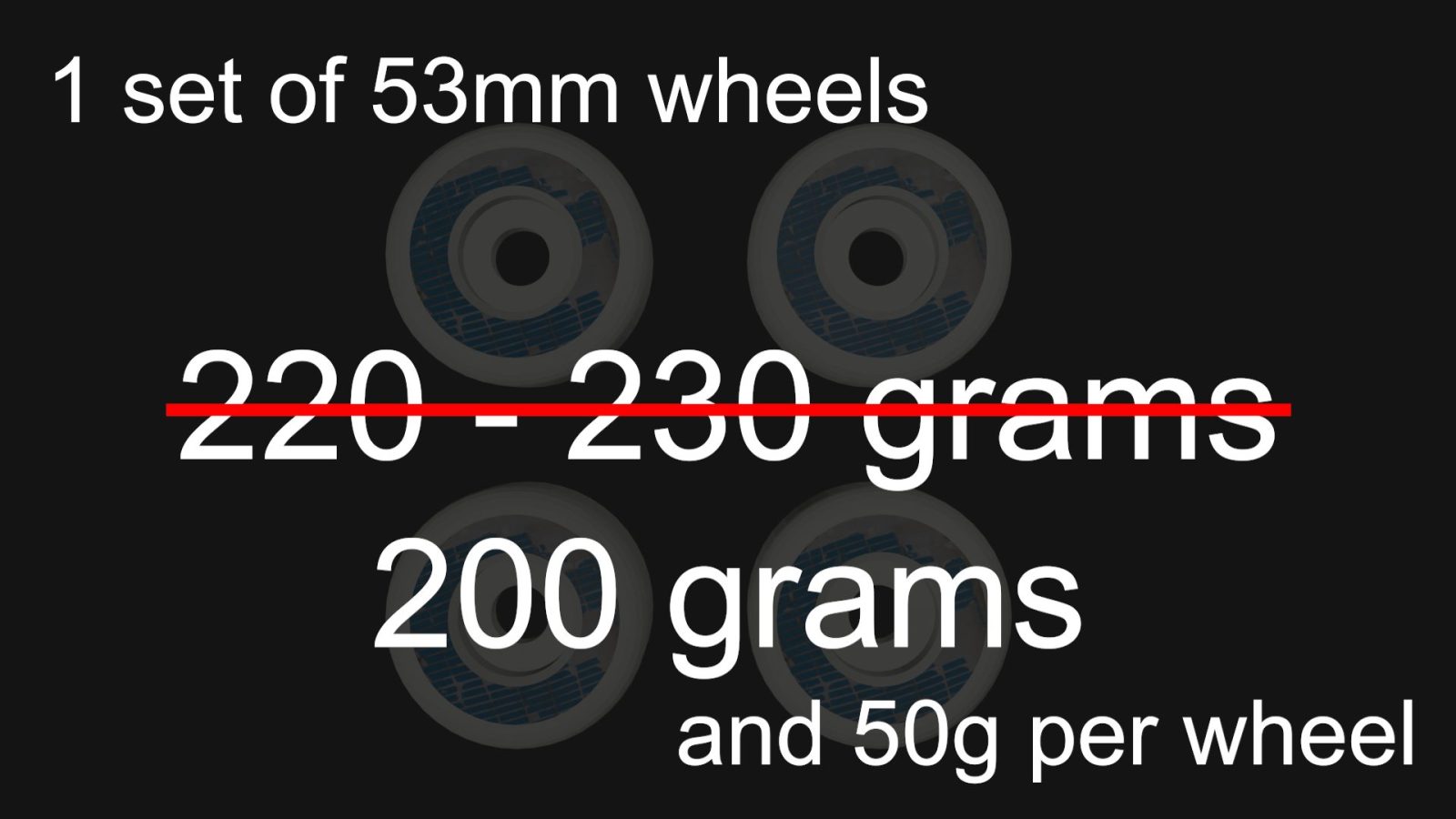
According to Bones’ official specifications, a set of 53 mm wheels weighs slightly above 200 grams. For the purpose of simulation, we will approximate this as precisely 200 grams per set, or 50 grams per wheel.
Weighing them
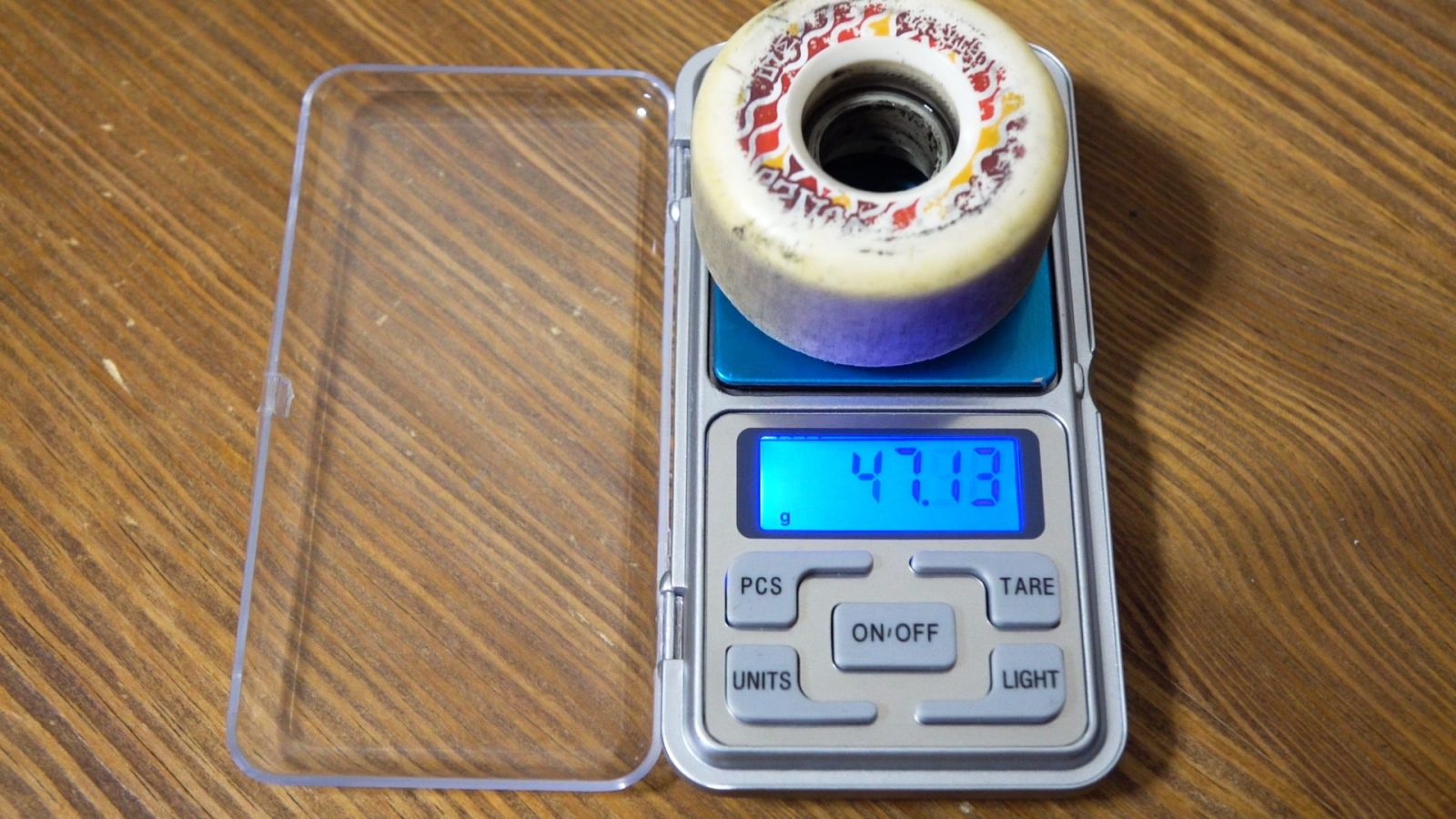
To verify this, let us measure the weight directly. The wheel shown here is a Bones 53 mm V2 shape model, which weighs 56 grams.
Since this value is reasonably close to the assumed 50 grams, we use 50 grams per wheel as a reference in our discussion.
The impact of a 3 mm difference
Skateboard wheels are typically offered in increments of about 3 mm.
For instance, many major brands produce wheels in sizes such as 50 mm, 53 mm, and 56 mm. Multiple sources indicate that a wheel gains approximately 4 grams for every 1 mm increase in diameter.
Thus, a 3 mm increase adds about 12 grams per wheel, or 48 grams per set.

3 mm of difference ≈ the weight of an egg
What everyday object weighs around 48 grams? An egg does.
Therefore, choosing 53 mm wheels instead of 50 mm adds roughly the weight of a single egg to your complete setup.
*The exact value varies depending on the wheel shape and formula.

What does “one egg of weight” do to flip tricks?
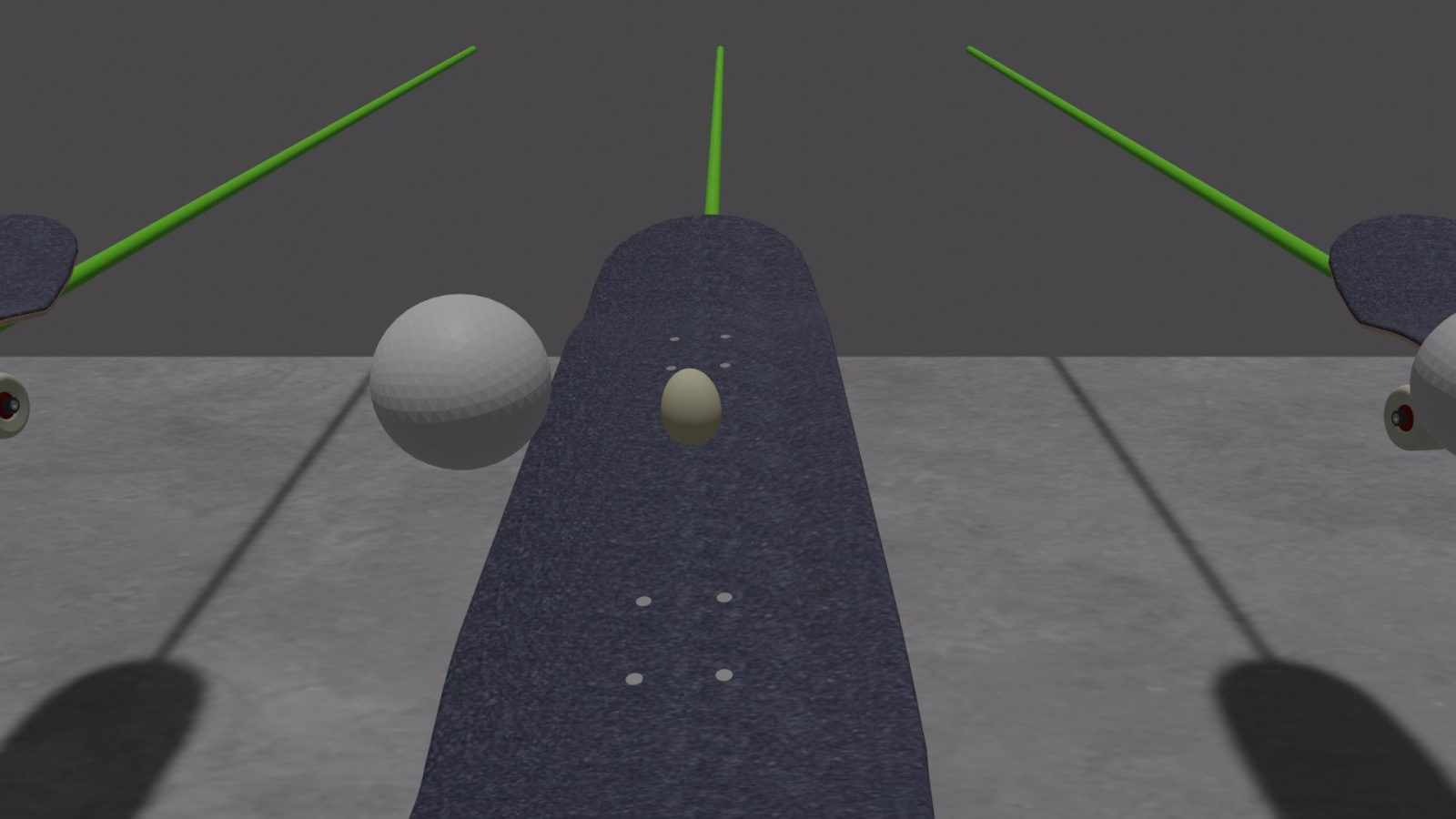
To investigate this, we compare three boards: a standard 3 kg board, a board made heavier by the equivalent of one egg, and another heavier by two eggs. External force is applied under identical conditions to observe how each board reacts.
*The weights attributed to the eggs are internally distributed in the simulation. The visible eggs on the graphics have no physical mass.

Experimental conditions
In this experiment, each board is suspended with its axis fixed, and a ball is dropped onto one side.
The contact points are mechanically computed to be identical across all trials. This allows a direct comparison of the energy required to flip the boards.
Results of the experiment
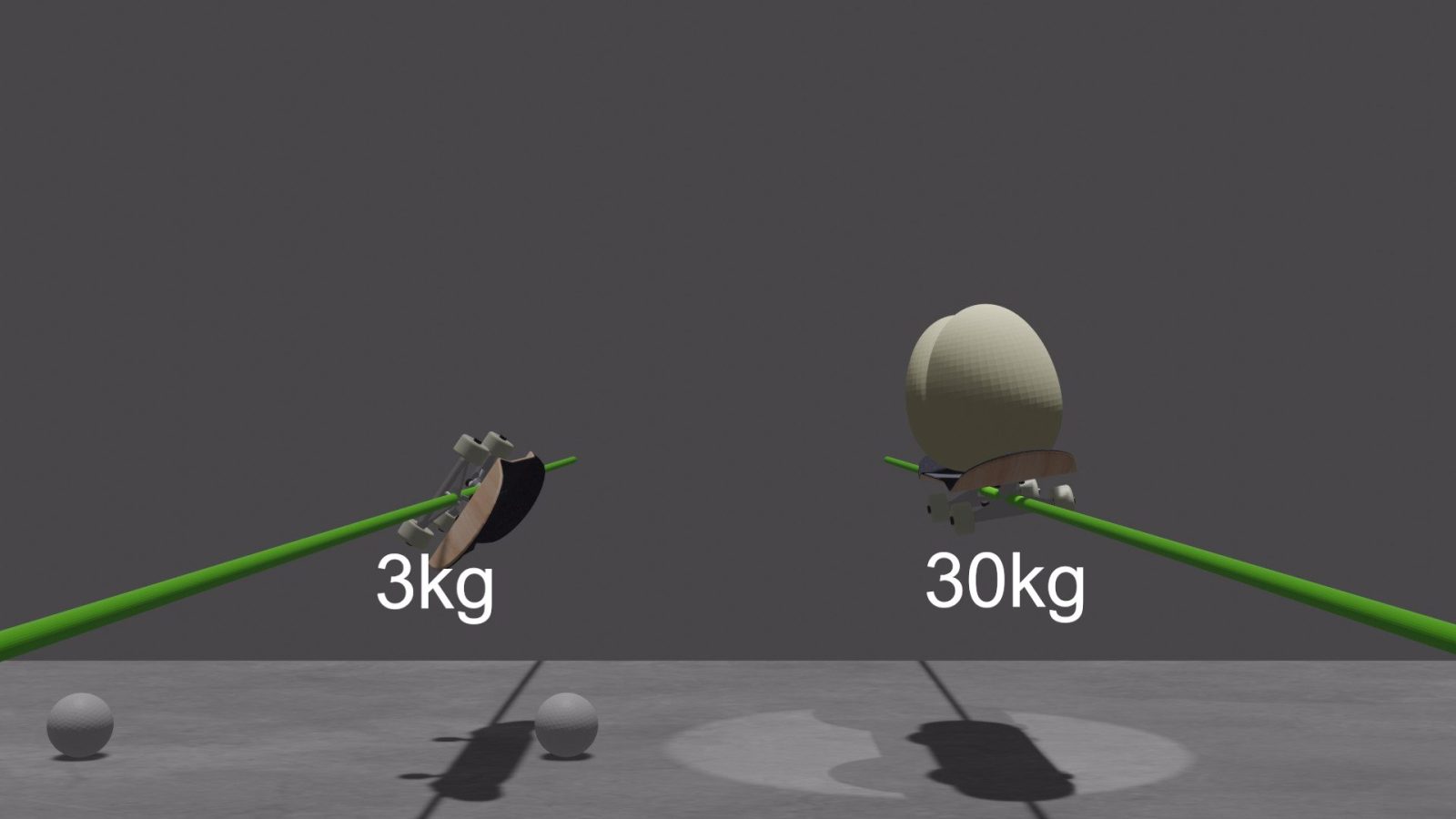
When the balls are dropped, the outcomes of the three boards remain nearly identical.
Only when the board’s total weight is increased to around 30 kg does the flip motion become notably slower.
This suggests the following: While board weight does influence flip performance, a difference equivalent to one or two eggs produces virtually no observable change.
For further detail, please refer to the accompanying video.
The impact on speed and ride quality
Common Theory
If wheel size has only a minimal effect on flip tricks, what about its influence on riding performance? In general, the following claims are often made:
- Larger wheels allow a higher top speed.
- Smaller wheels allow faster acceleration.
Are these claims correct? Let us verify them using a physics engine.

Experimental setup
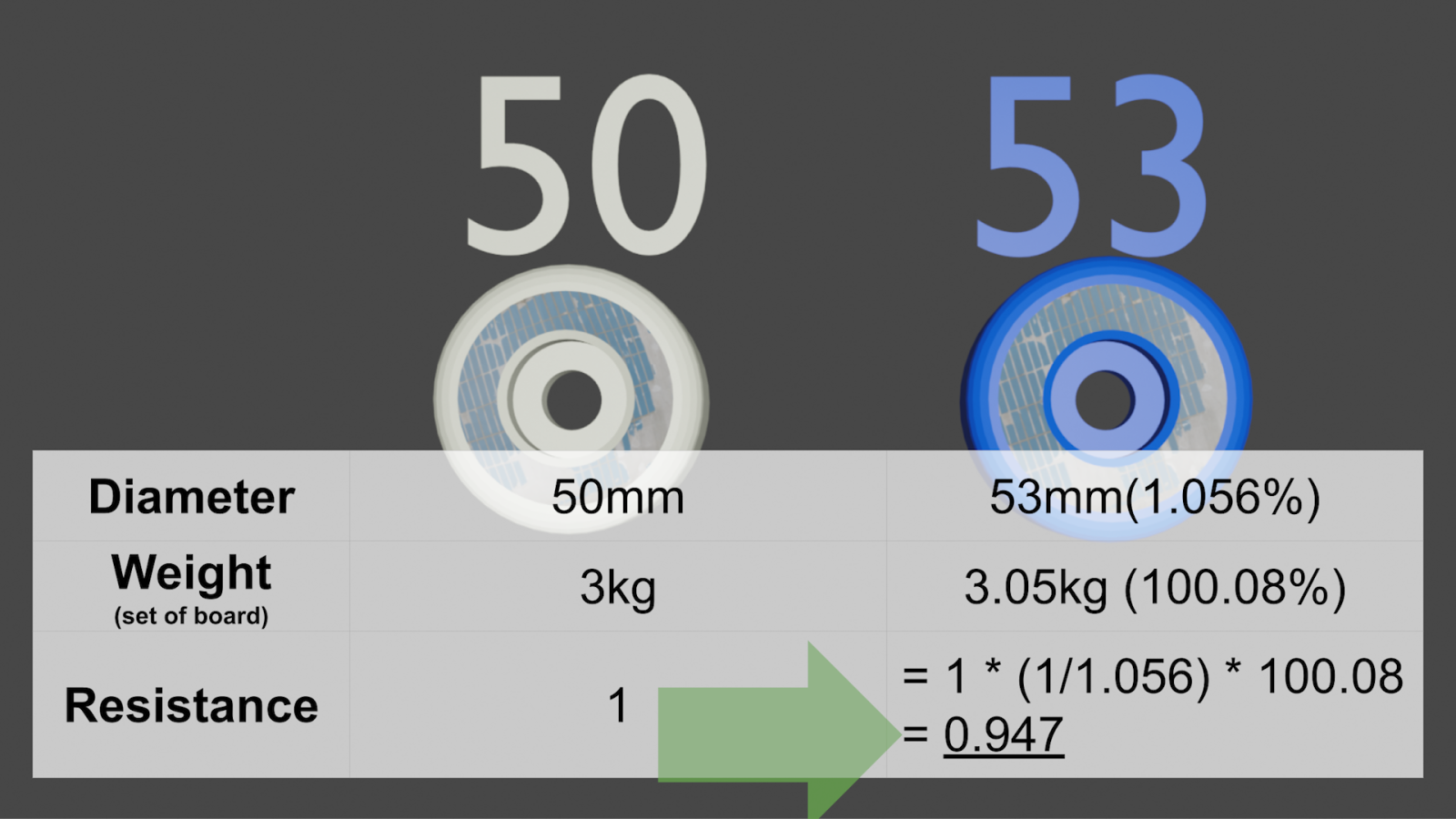
In simple terms, Heavier wheels are less willing to roll, whereas larger-diameter wheels roll more easily.
Results of the experiment
When each model was allowed to glide on a smooth surface, the setup equipped with the largest wheels traveled the farthest.
An affecting factor is rolling resistance. As wheels grow larger, they receive less deformational resistance from the ground and are able to maintain speed over a longer distance.
Why the difference grows on rough surfaces
The tendency becomes even more pronounced on rough or uneven terrain. Because larger wheels experience less resistance from surface irregularities, they travel farther and maintain speed more effectively than smaller wheels.