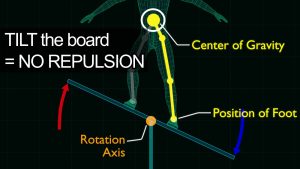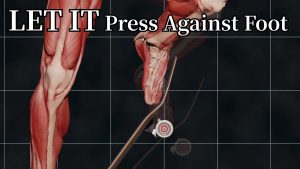
In an Ollie, why does the tail rise together with the back foot even though they are not attached? If we simplify the essential requirements for lifting the tail, the idea is quite straightforward: raise the entire board and lower the nose. In other words, the front foot needs to move straight up, then press down. So why does something that sounds this simple become so difficult in practice? The reason is that the common practice method creates unexpected side effects. Let's see it in detail.
Instantly discover issues with your tricks and how to fix them.
Deep analyze your motion with the cutting-edge technology.

Track your daily progress and ask questions to others.
The Mechanism That The Tail Lifts
To understand why the tail follows the back foot, let's first imagine what would happen in a zero-gravity environment. Suppose you are floating in space and the board is moving upward. In that situation, if you press down on the nose, the board will rotate, and the tail rises as a result. An Ollie works on exactly the same principle. In other words, there are two key requirements for lifting the tail: First, the entire board must have an upward force. And second, a downward force must be applied to the nose.
So, how can we strengthen these forces? Let's begin with the upward force that lifts the entire board. At first glance, it may seem that popping the tail is what creates this force—but that alone is not enough, as popping primarily causes the board to rotate. In reality, it is the front foot that significantly contributes to lifting the board. As the board rotates, friction is created between the deck and your front foot. By pulling your front foot upward, the board lifts with it.
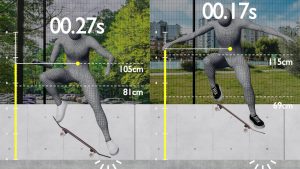
Now, let's take a closer look at the motion of the front foot in an actual Ollie. As you push off the ground, the front foot begins to rise vertically. It continues upward until your knee is compressed toward your chest, reaching a point where it can no longer rise any higher. Up until the peak, the motion is purely vertical, or the front foot is even slightly pushed back by the nose. The point is that the front foot never moves forward until it reaches the peak, and accelerates the board's upward momentum by lifting vertically. This is how the upward force acting on the entire board is generated—one of the key requirements for lifting the tail.
Next, to create the second force—the downward force on the nose—you must immediately transition after lifting your front foot and begin to push it down. It's downward. Not forward. You must have heard someone say, "push your front foot forward." However, from a physics standpoint, what is required to lift the tail is a downward force, not a forward one.
When the front foot is lifted, the board pushes it back. Then, as it tries to unwind its tension, it moves forward. In other words, if you lift your front foot sufficiently and allow it to be pushed back by the board, it will naturally move forward on its own. What you should focus on is not pushing the front foot forward, but rather generating the second essential force needed to lift the tail—pressing the nose downward. Then, the unwinding motion and the downward push of the front foot combine, making a keen plunging path.
The Mechanism When The Tail Doesn't Lift
The biggest issue lies in the common practice of sliding the front foot against the board. Again, you want to lift your front foot upward vertically to increase the upward force on the entire board. However, if you instead press your front foot against the board, it ends up canceling out the board's rotation, rather than contributing to upward lift. As a result, the board begins to fall, without ever gaining the height you want.
Furthermore, when you focus too much on sliding your foot forward, you naturally won't be able to lift your front foot and knee. If you slide vertically up, your knee can reach as high as your chest. But now, because your leg's energy is consumed by the rotation of the board, it stays much lower. You are fighting an unnecessary battle against the board, only to waste precious energy you need to lift your front foot and knee.
Let's trace the actual path of the knee. If you manage to do it right, it goes really high, as if it touches the chest, and then quickly plunges down as a result of pushing the nose downward. If you slide your front foot forward from the beginning, this mountaneous path never appears: it doesn't accelerate the board's upward force, and it doesn't lower the nose.
As we've established, lifting the front foot high is essential for achieving a higher Ollie. But whether it means you just have to pull up your front foot as high as possible, the answer is no. As explained in another video with an example of a seesaw, simply pushing down with your back foot and lifting your front foot does not move your center of gravity. While your front foot may indeed rise, you will not gain any airtime, and your Ollie becomes low.
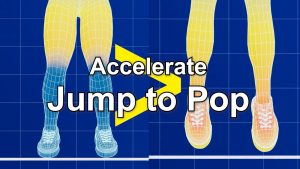
Furthermore, if you lift your front foot vertically, the board needs sufficient rotational force to remain in contact with it. To make that happen, you need to pop harder. Don't think about the popping motion as an isolated motion. Pop is an act of accelerating the energy generated by jumping and transmitting it all the way to the tail. Meaning, everything starts with good jumping using both feet. Once you jump, you'll be able to lift your front foot with your body weight.
Is Pushing the Front Foot Forward Always Wrong?
Pushing the front foot forward is not always evil. In fact, for lower Ollies or Ollies that cover longer distances, you do need to push your front foot forward. Let's consider what happens when you lightly pop the tail. Naturally, the board's rotation becomes weaker. Unlike when the board has sufficient rotational force, in this case, if you lift your front foot too high, it will lose contact with the board.
When you pop the tail lightly, pushing the front foot slightly forward helps maintain contact between your foot and the board. In that sense, it is important to adjust the direction of your front foot depending on the height of the Ollie you are practicing.