

In this article, we’ll focus on more fundamental WHYs behind this trick. Like “Why can’t you lock in?” or “Why does the truck hang up?” There are logical reasons. If you understand the reasons behind what’s happening, you’ll be able to approach the trick much more comfortably.
Instantly discover issues with your tricks and how to fix them.
Deep analyze your motion with the cutting-edge technology.
Track your daily progress and ask questions to others.
The mechanics of coming back in
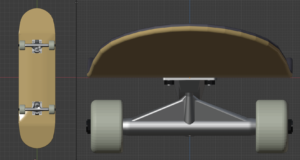
It is a reversed order, but let’s think about the motion of coming back in first. As many tutorials say, it’s better to lock with your heel. There are two reasons behind this. First, it’s safer due to the structure of the trucks. When you rotate your board, using the toe-side wheel as the pivot leaves a larger portion of the truck on the ramp, which makes it easier to hang up. Whereas, when you use your heel, with the same angle of rotation, only the heel-side wheel is on the ramp, minimizing the risk of hanging up.
Second, the structure of the human body itself makes it easier for the truck to get caught if you use your toe. Whether it’s an axle stall or just walking, or coming out of a grind trick on a ledge, when humans step forward, we naturally shift our weight onto our toes so that we can use the motion of the ankle. If your toe is on the coping and you use your ankle like so, the board slides toward the deck of the ramp, causing the truck to hang up.
Now, imagine when you use your heel. No matter how much you press down on your toe, the board will only tilt inward—there’s no reason for the board to get onto the ramp more deeply. Get it? As long as the heel-side wheel becomes a pivot, pressing down on the toe can never cause the truck to hang up. Furthermore, your body axis naturally leans forward, allowing you to come out of the stall with much less effort.
The mechanics of locking in
Next, locking in. When you’re riding up the ramp with sufficient speed, a force acts on your body that tries to carry you outside the ramp. If you do nothing, this force will cause you to ride up onto the deck.
So what happens if you add a pumping motion and you extend your body? Your back heel presses down, and the truck is pushed against the coping. At the same time, the center of gravity is pushed diagonally upward toward the inside of the ramp, forming a solid body axis.
Because the force that tries to push your body outward is still present, it raises your body axis, allowing you to come to a stop. Therefore, the motion of locking in is not a conscious effort to place your weight onto the coping. Instead, it is an act of pressing the rear truck against the coping by pumping while extending and straightening your body axis.
This is also why it’s better to lock in on the heel rather than the toe. Until your body axis rises into an upright position, your back foot continuously presses down on the coping. When using your heel, your entire leg supports your body weight and stabilizes your body axis.
On the other hand, it is still possible to Axle Stall using the toe, but this requires an additional action of locking the ankle. Imagine you are standing on your toes and receive a vertical force. It’s the ankles that bend first because they are relatively weaker than other muscles, like the thighs. If the ankle bends like so upon locking in, the body axis can unintentionally tip or collapse. It’s not wrong to use your toe; it just gives you one more thing you have to deal with, which can make it harder. So, why not use your heel?
The Line of Sight
One of the trickiest aspects of locking in is your line of sight. Because you can already see where you want to lock in during the approach, it’s very tempting to rotate the board too early. If you do so, you end up doing something like an incomplete boardslide.
The essence of an Axle Stall is delivering the heel-side wheel to the coping by pumping. Doing a manual while turning has a lot in common with the feeling of supporting your weight on the heel. Gradually increase the height until you can get the rear truck over the coping. Plus, during actual riding, you can’t see your feet. So, learn the feeling of the wheel hitting the coping.
If you are having a hard time locking in, it might be a timing issue. You can always visualize your movement with Whythetrick’s motion analyzer by adding gridlines to your video. You can also play videos side by side so you can compare a successful attempt with a failed one. Please make good use of it.

7 Replies to “Why does the Axle Stall hang up on coping? Scientifically explained”