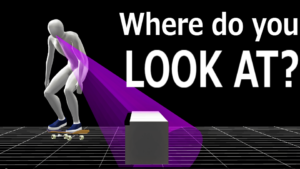
Even if one can perform ollies and backside 180s, it is still common to struggle with locking into the correct position.
In my own experience, I sometimes end up landing in a feeble-like position, slipping into a boardslide, tipping into a wheelie, or even missing the ledge entirely.
In this series, we examine why these issues occur from the perspective of physics, making use of 3D models as usual.


Instantly discover issues with your tricks and how to fix them.
Deep analyze your motion with the cutting-edge technology.
Track your daily progress and ask questions to others.
Summary
Above all, proper timing is everything
Instability during the grind, or inability to pop out are all common issues, yet failing to lock in correctly appears to be the most significant challenge. With proper timing, this issue can often be addressed.
Maintain your posture briefly.
When crouching, the body acquires downward momentum. This vertical force pushes the body downward and interferes with getting onto the ledge. To avoid working against this force, maintain your posture momentarily and allow your joints and muscles to absorb or dissipate the energy as heat.
Jump earlier when approaching a higher ledge.
When skating a higher ledge, it is necessary to use the downward momentum to tense the muscles and generate a stronger upward jump. To achieve this, one should initiate the jump immediately after crouching, before the body absorbs the energy.
Simulation
Select the icon to view the 3D simulation.













Classification of problems
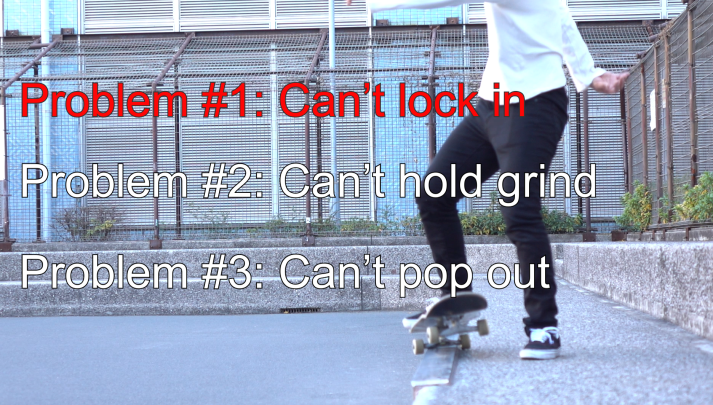
Let us begin by categorizing the common issues. They can be divided into the following groups:
- Difficulty locking in.
- One may inadvertently land in a feeble-like position, slip into a boardslide, or tip into a wheelie grind.
- Difficulty maintaining the grind.
- This may cause the skater to step off toward the heel side.
- Alternatively, one may come off the ledge earlier than intended.
- Difficulty popping out properly.
From my observations, the first issue appears to be the most prevalent among skaters.
Approach to solution
Now that the primary issues are identified, let us consider solutions. In this article, we focus on one essential factor: timing.
Since timing is the central topic, we take a slightly unconventional approach and work backward.
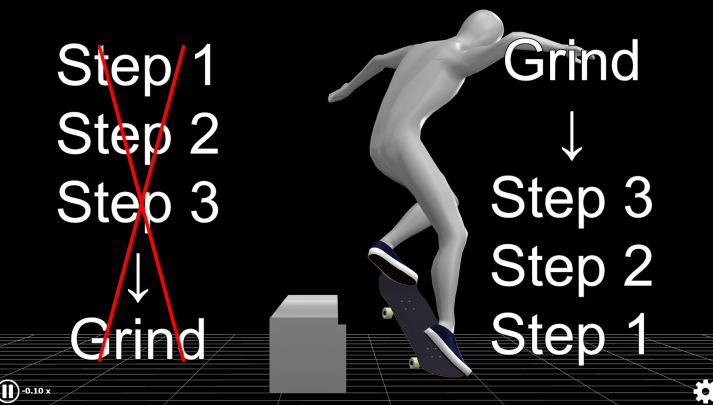
Where does your body need to be?
Imagine the moment you are already grinding. At the moment of grinding, the body must be positioned appropriately above the ledge.
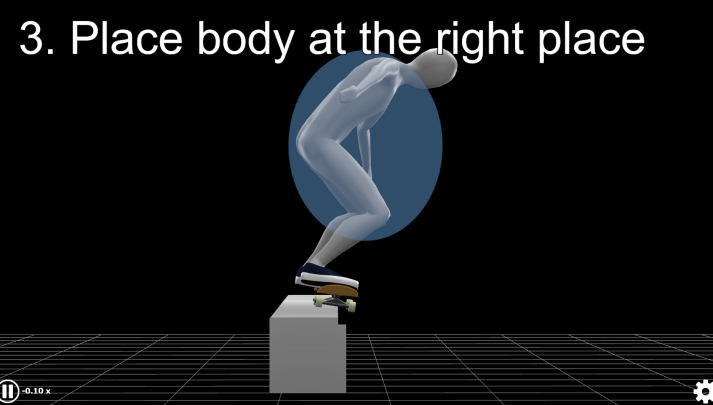
How does the body reach this position?
The exact posture and weight distribution vary depending on speed and approach angle, but generally, you should pop right next to the ledge.

What precedes the pop?
Looking further back in the sequence, the skater must first crouch down in preparation for the pop.

Cause of problem
The crucial point lies at the beginning
In fact, the most important phase is the very beginning.
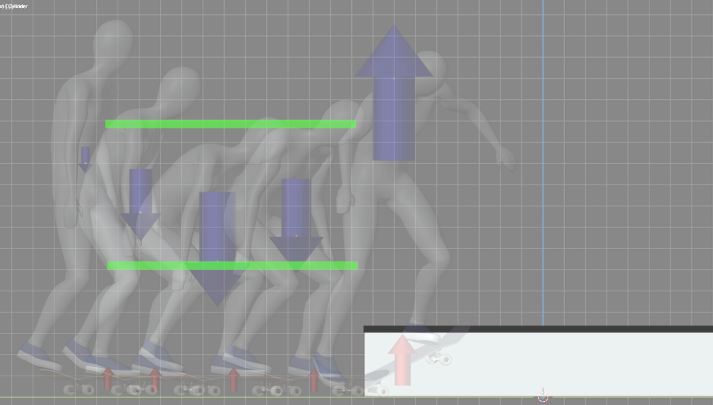
When crouching, the body acquires downward momentum. This vertical force drives the entire body downward, making it more difficult to initiate an effective upward jump.
If one attempts to pop simultaneously, the downward momentum from the body's descent and the upward force from the pop oppose each other, effectively compressing the legs.
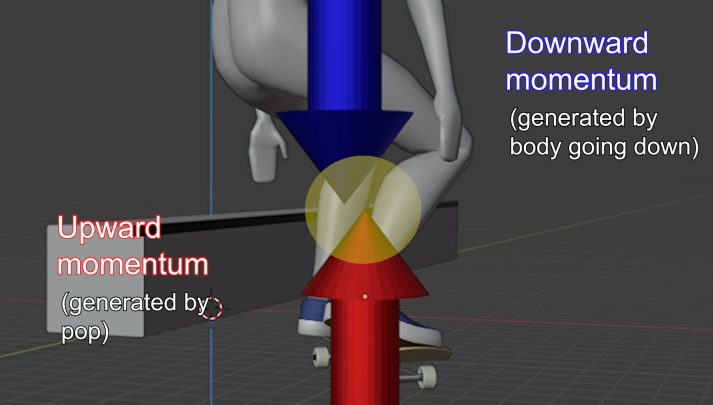
As a result, no matter how forcefully one attempts to pop, the body cannot rise sufficiently because the timing is unfavorable.
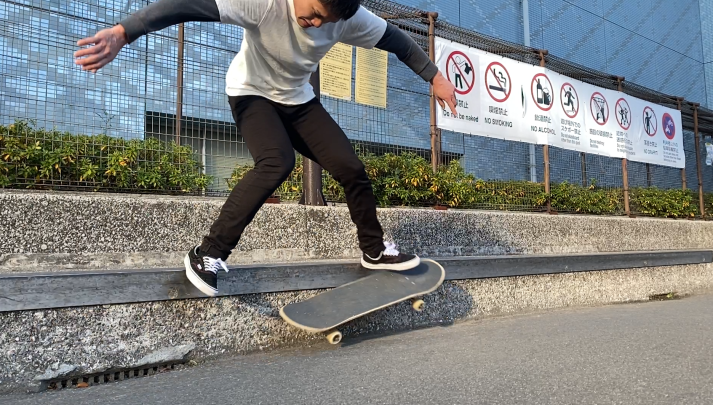
With limited airtime, it becomes difficult to adjust the board’s angle, often causing the skater to land in a feeble-like position or unintentionally enter a boardslide.
Solution
Working against downward momentum is the primary cause
It is important to recognize that downward momentum does not persist indefinitely.
Consider the sensation of dropping from a small height. Upon landing, the body absorbs the impact, yet that heavy feeling dissipates almost immediately. In a similar manner, the downward momentum generated during the crouch only lasts for a brief moment.
This is because the joints and muscles of the body absorb the energy and convert it into heat.
The advantage of maintaining a low posture
The key point is that this energy dissipation occurs naturally; the body performs it as a reaction.
Therefore, if the goal is to avoid pushing against downward momentum, why not simply wait for a moment?
In other words, by maintaining the crouched posture briefly, the body can naturally absorb the downward momentum through its muscles and joints.
By doing so, not only is the downward energy dispersed, but the body axis becomes more stable, allowing for a more controlled upward motion with less effort.
Execution
How to apply the concept
Along with the previous idea, it is essential to remember the distinct roles of the thighs and calves.
The pop itself is performed using the calves, but they are not powerful enough to lift the entire body. That role is carried primarily by the thighs.
Therefore, be sure to extend the legs with the thighs first, and then initiate the pop.